Difference Between LLP Agreement and Partnership Deed (2026 Guide)
Introduction
Many entrepreneurs planning to start a business often come across two important legal documents: the LLP Agreement and the Partnership Deed. Although both documents define the relationship between business partners, they are not the same. They apply to different business structures and are governed by different laws. Understanding the Difference Between LLP Agreement and Partnership Deed is essential before choosing the right legal structure for your business.
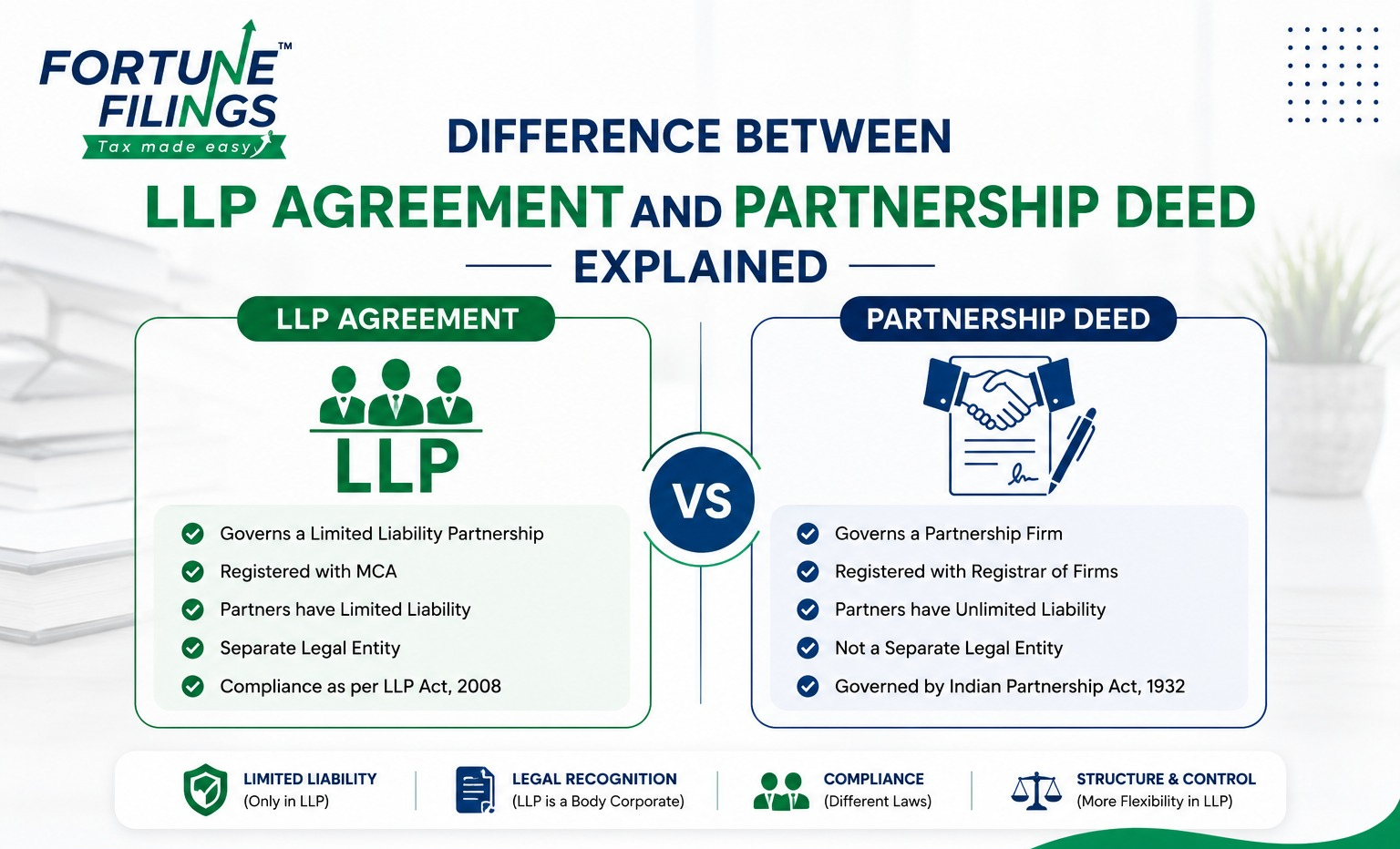
An LLP Agreement is executed when forming a Limited Liability Partnership (LLP) under the Limited Liability Partnership Act, 2008, whereas a Partnership Deed is used when establishing a traditional partnership firm under the Indian Partnership Act, 1932. While both documents outline the rights and responsibilities of partners, the legal implications, liability, compliance requirements, and business advantages differ significantly.
Businesses planning LLP Registration in Chennai often choose the LLP structure because it provides a separate legal identity, limited liability protection, and better long-term business flexibility. Understanding how an LLP Agreement differs from a Partnership Deed helps entrepreneurs make informed decisions before registering their business.
What Is an LLP Agreement?
An LLP Agreement is the primary legal document that governs the internal management of a Limited Liability Partnership.
It defines how the LLP will operate by specifying:
Rights and duties of partners
Profit-sharing ratio
Capital contribution
Decision-making powers
Admission of new partners
Retirement of partners
Dispute resolution procedures
Management responsibilities
The LLP Agreement forms the operational framework of the LLP and is an important document after incorporation.
Businesses planning incorporation can also refer to LLP Agreement: Format, Mandatory Clauses, Stamp Duty & Filing Guide (2026) to understand the essential clauses that should be included in an LLP Agreement.
What Is a Partnership Deed?
A Partnership Deed is a legal agreement executed between partners of a traditional partnership firm.
It records the mutual understanding between the partners regarding:
Business objectives
Profit-sharing ratio
Capital contribution
Duties and responsibilities
Salary or remuneration
Admission and retirement of partners
Dissolution procedures
Although registration of a partnership firm may be optional in many cases, executing a Partnership Deed helps reduce disputes among partners.
Governing Law
One of the biggest differences lies in the law governing each business structure.
LLP Agreement
Governed by:
Limited Liability Partnership Act, 2008
Partnership Deed
Governed by:
Indian Partnership Act, 1932
Because these laws differ, the rights, liabilities, and compliance requirements also vary significantly.
Separate Legal Identity
An LLP has a separate legal identity from its partners.
This means the LLP can:
Own property
Enter contracts
Sue and be sued
Continue operations despite changes in partners
Traditional partnership firms generally do not enjoy this separate legal status.
Entrepreneurs interested in business asset ownership may also find Can an LLP Own Property in India? Legal Rules Explained useful for understanding how property ownership differs in an LLP.
Limited Liability
One of the most significant advantages of an LLP is limited liability.
Partners are generally liable only to the extent of their agreed contribution.
In a traditional partnership, partners may have unlimited liability depending on the circumstances, making personal assets more exposed to business risks.
This liability protection is one of the primary reasons entrepreneurs increasingly prefer LLPs.
Registration Requirements
An LLP must be registered with the Ministry of Corporate Affairs (MCA).
The LLP Agreement is filed as part of the post-incorporation compliance process.
A Partnership Deed, however, is executed between partners, and while registering the partnership firm may be beneficial, it is governed by a different legal framework.
Businesses considering LLP Registration in Chennai often prefer the LLP structure because of its legal recognition and corporate credibility.
Comparison Between LLP Agreement and Partnership Deed
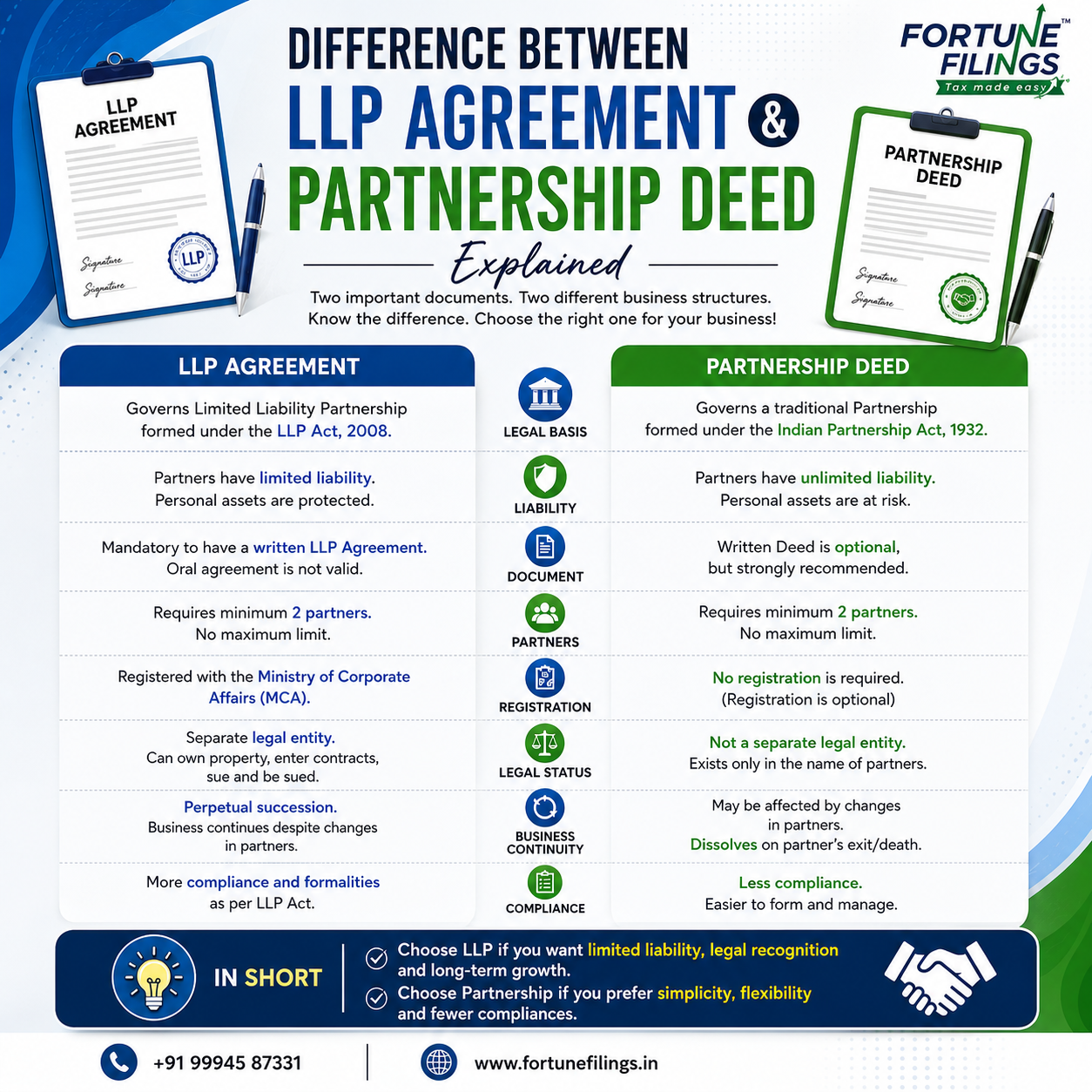
Feature | LLP Agreement | Partnership Deed |
Governing Law | LLP Act, 2008 | Indian Partnership Act, 1932 |
Business Structure | Limited Liability Partnership | Partnership Firm |
Separate Legal Entity | Yes | No |
Liability of Partners | Limited | Generally Unlimited |
Registration Authority | Ministry of Corporate Affairs | Registrar of Firms (where applicable) |
Legal Status | Body Corporate | Partnership Firm |
Business Continuity | Perpetual Succession | May be affected by partner changes |
Ownership of Business Assets
An LLP owns its assets independently of its partners.
This includes:
Office premises
Machinery
Vehicles
Intellectual property
Bank accounts
In contrast, property ownership within a traditional partnership may depend on how assets are acquired and documented.
Proper ownership structures help businesses avoid disputes in the future.
Business Continuity
An LLP enjoys perpetual succession.
This means the LLP continues to exist even if:
A partner retires
A partner resigns
A new partner joins
Ownership changes
Traditional partnership firms may require reconstitution under certain circumstances.
Businesses planning long-term growth generally prefer structures that provide continuity.
Compliance Requirements
LLPs generally have structured compliance requirements, including:
Annual Return Filing
Statement of Account and Solvency
Maintenance of books of accounts
Audit where applicable
Partnership firms have comparatively different compliance obligations depending on applicable laws.
Understanding compliance before choosing a business structure helps entrepreneurs plan effectively. Businesses can also refer to LLP Annual Compliance Checklist for a complete overview of LLP post-registration responsibilities.
Admission and Retirement of Partners
Both documents include provisions relating to:
Admission of new partners
Retirement
Resignation
Death of partners
However, LLP Agreements usually provide more detailed procedures because LLPs operate under a structured corporate framework.
If partner changes are anticipated, How to Add or Remove Partners in an LLP (2026) explains the legal process involved after incorporation.
Profit Sharing
Both documents define the profit-sharing ratio among partners.
The agreement should clearly specify:
Capital contribution
Profit distribution
Loss sharing
Drawings
Partner remuneration
Clearly drafted clauses help prevent future disputes.
Dispute Resolution
Both documents usually contain dispute resolution provisions.
These may include:
Mutual discussions
Mediation
Arbitration
Legal proceedings
Having well-defined dispute resolution clauses helps protect business relationships and ensures smoother conflict management.
Which One Should You Choose?
The choice depends on your business goals.
A Partnership Deed may be suitable for businesses seeking a traditional partnership arrangement with relatively simple operational requirements.
An LLP Agreement is generally preferred by businesses looking for:
Limited liability protection
Separate legal identity
Better credibility
Long-term business continuity
Scalability
Structured governance
Startups, consultants, professionals, IT companies, manufacturing businesses, and growing enterprises often choose LLPs because they combine operational flexibility with stronger legal protection.
Common Mistakes to Avoid
Entrepreneurs should avoid:
Assuming an LLP Agreement and Partnership Deed are the same.
Using an outdated agreement format.
Omitting important clauses relating to partner responsibilities.
Not clearly defining profit-sharing arrangements.
Ignoring legal compliance requirements after registration.
Failing to update agreements when business circumstances change.
Proper drafting and regular review of business agreements help reduce future disputes and ensure smoother business operations.
Importance of Professional Drafting
Whether preparing an LLP Agreement or a Partnership Deed, professional drafting ensures that:
The rights of all partners are clearly defined.
Business objectives are properly documented.
Legal requirements are addressed.
Future disputes are minimised.
Compliance obligations are clearly understood.
A well-prepared agreement provides a strong legal foundation for long-term business success.
Conclusion
Understanding the Difference Between LLP Agreement and Partnership Deed is important for entrepreneurs choosing the right business structure. While both documents regulate the relationship between partners, they operate under different laws and apply to different forms of business. An LLP Agreement governs a Limited Liability Partnership and offers advantages such as separate legal identity, limited liability, perpetual succession, and structured compliance. A Partnership Deed, on the other hand, governs a traditional partnership firm and follows a different legal framework.
For entrepreneurs planning LLP Registration in Chennai, choosing an LLP with a properly drafted LLP Agreement provides greater legal protection, operational flexibility, and long-term business stability. Before registering a business, it is advisable to understand the legal implications of each structure so that the chosen model aligns with future business goals, growth plans, and compliance requirements.