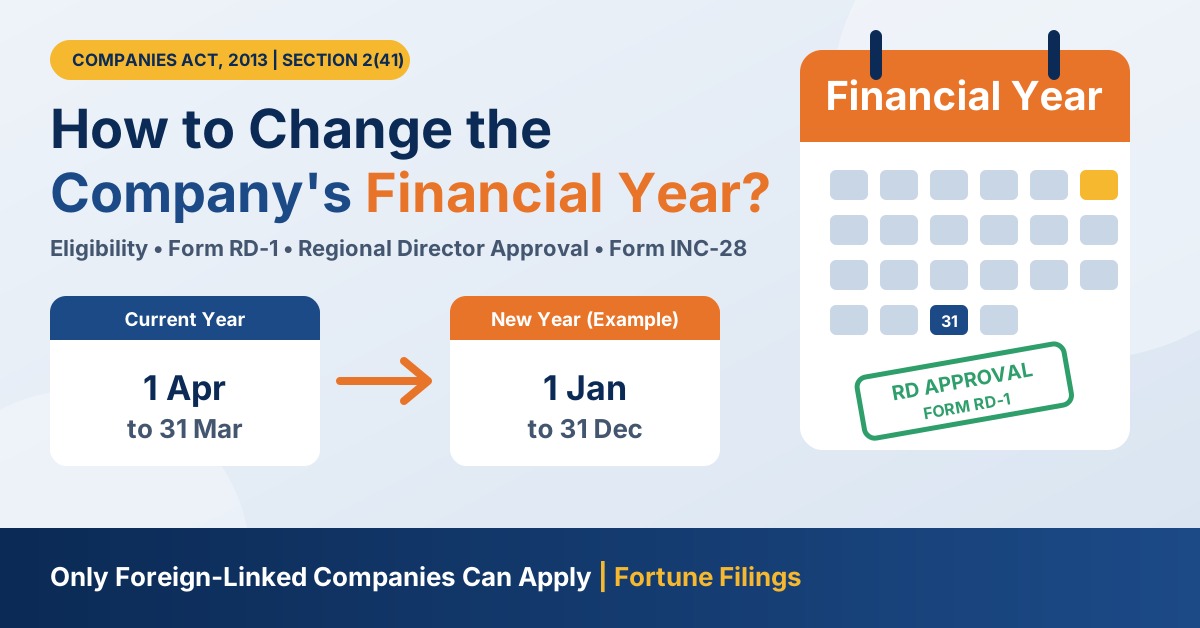
Every company needs a fixed accounting period to prepare its books, pay taxes and report to the government. In India, that period is called the financial year. Most business owners never think about it, because the default is simple: 1 April to 31 March. But some companies, especially those owned by or linked to foreign groups, need a different year-end to match their parent company’s reporting. That is when the question comes up: how do you change the company’s financial year?
In this guide, Fortune Filings explains the rules under the Companies Act, 2013, who can change the financial year, the step-by-step process with the Regional Director, the forms, documents and common mistakes to avoid.
What Is a Financial Year of a Company?
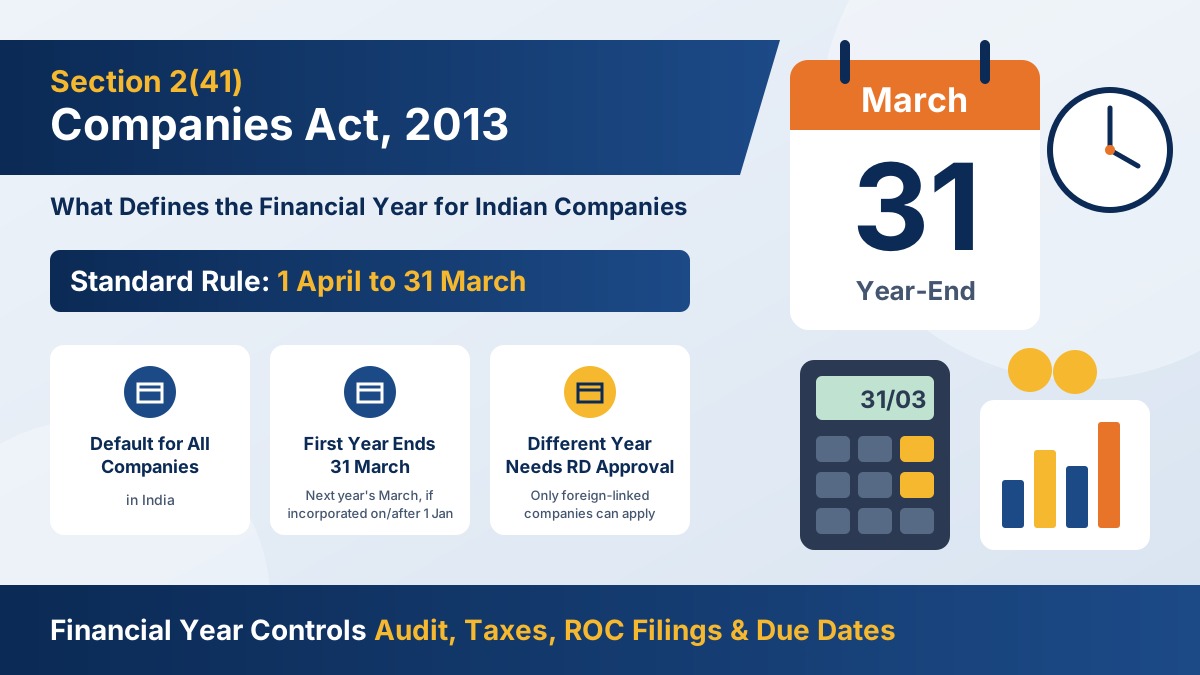
Under Section 2(41) of the Companies Act, 2013, the financial year of a company is the period ending on 31st March every year. For a company incorporated on or after 1st January of a year, the first financial year can end on 31st March of the following year.
All the key yearly activities of the company follow this period:
Preparation of financial statements (balance sheet and profit and loss account)
Statutory audit
Annual General Meeting (AGM)
Filing of annual returns and financial statements with the Registrar of Companies (ROC)
Income tax and GST compliance
Can a Company Change Its Financial Year?
Here is the most important point to understand before you start: not every company can change its financial year.
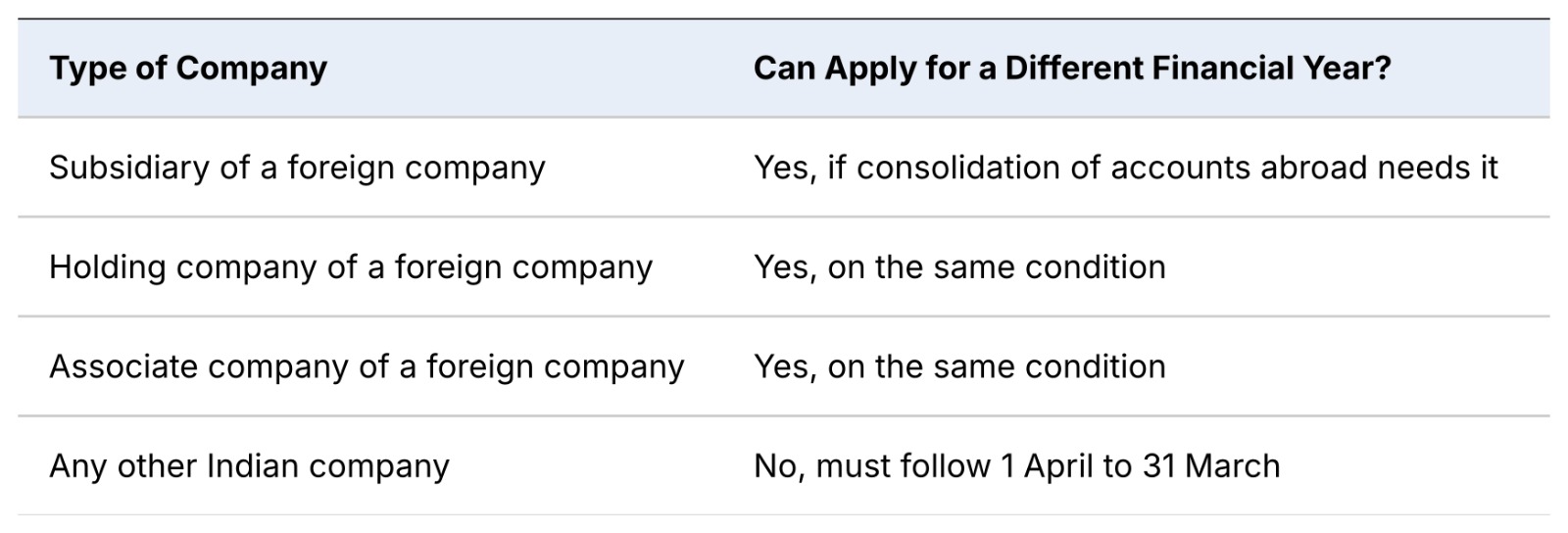
The law says every company must follow the April to March cycle. The only exception is for a company that is a holding company, subsidiary company or associate company of a company incorporated outside India, and is required to follow a different financial year for consolidating its accounts outside India. Such a company can apply to the Central Government, whose powers are exercised by the Regional Director (RD), for permission to use a different financial year.
If your company does not fall in this category, it must continue to follow the 1 April to 31 March year.
Also note that:
A company that has already been permitted to follow a different financial year can apply to change it again, including going back to April to March, with approval.
Before 2019, this approval was given by the National Company Law Tribunal (NCLT). Now the application goes to the Regional Director.
Who Is Eligible to Change the Financial Year?
If you are setting up a new company and are not sure about the structure, see our Private Limited Company registration page for guidance.
Why Do Companies Change Their Financial Year?
Common reasons include:
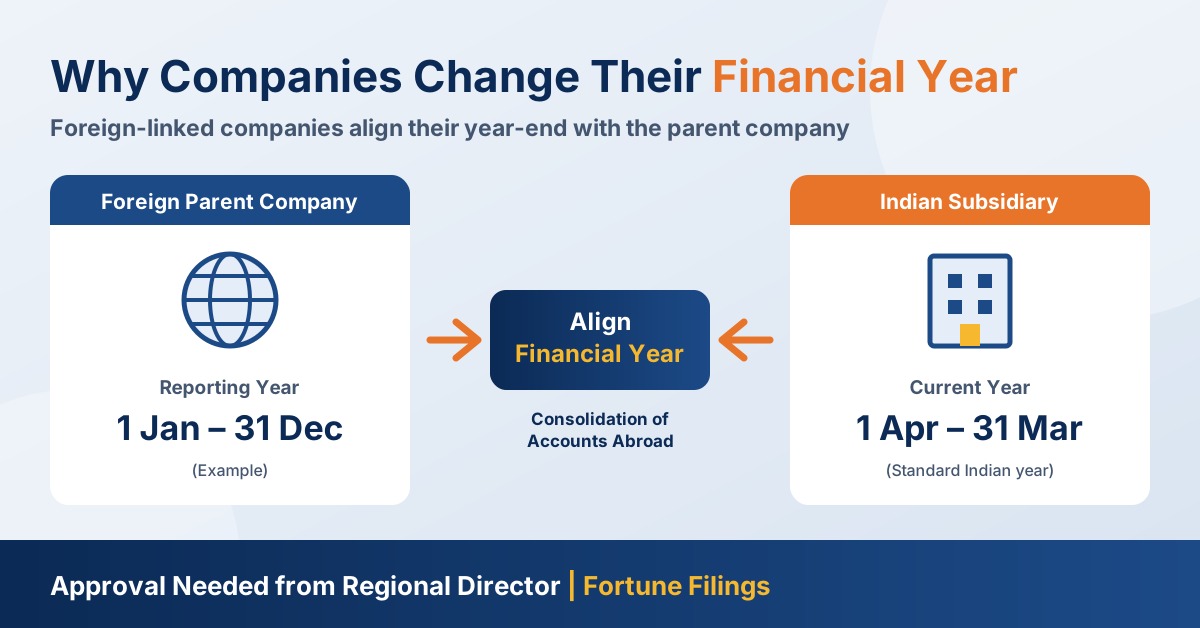
The foreign parent company follows the calendar year (January to December) or another year-end
Consolidation of accounts at the group level
Alignment with global audit and reporting timelines
Aligning with the business or seasonal cycle of the group
Bringing the company back to the standard April to March cycle
Documents Required to Change the Financial Year
Keep these ready before filing:
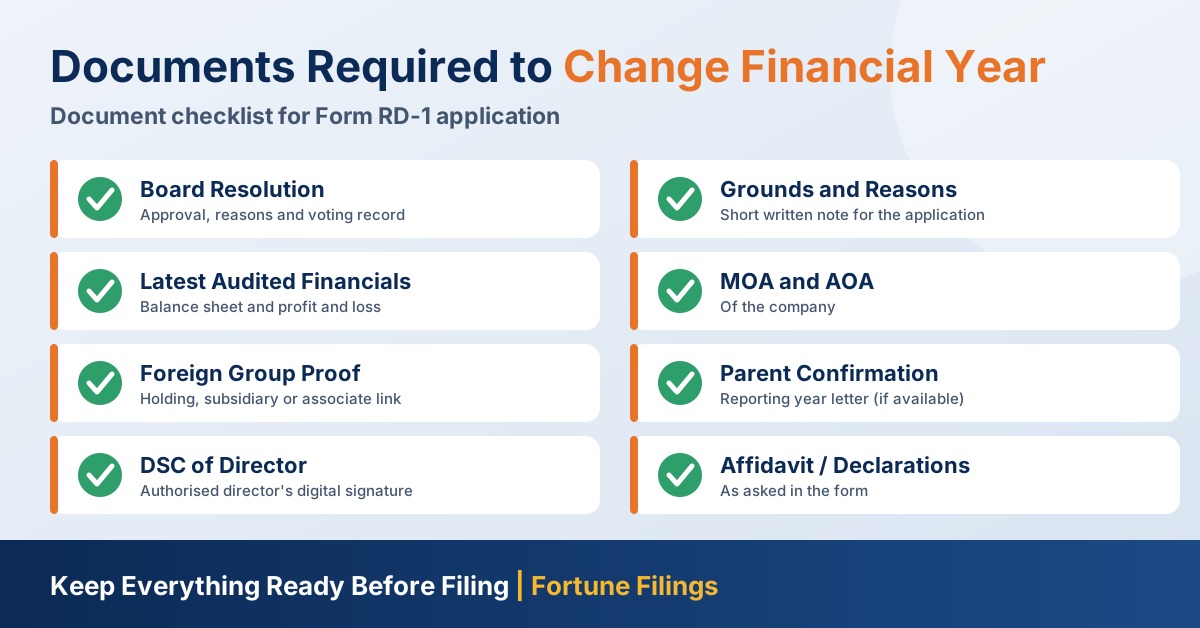
Board resolution approving the change, with the reasons and the voting record
Grounds and reasons for the application, in a short written note
Copy of the latest audited financial statements
Memorandum and Articles of Association (MOA and AOA) of the company
Details of the holding, subsidiary or associate relationship with the foreign company, with supporting proof
Letter or confirmation from the parent company about its reporting year, if available
Digital Signature Certificate (DSC) of the authorised director, as the form is filed online
Affidavit or declarations as asked in the form
Need a DSC for signing the forms? Our team can arrange a Digital Signature (DSC) quickly.
Step-by-Step Process to Change the Financial Year of a Company
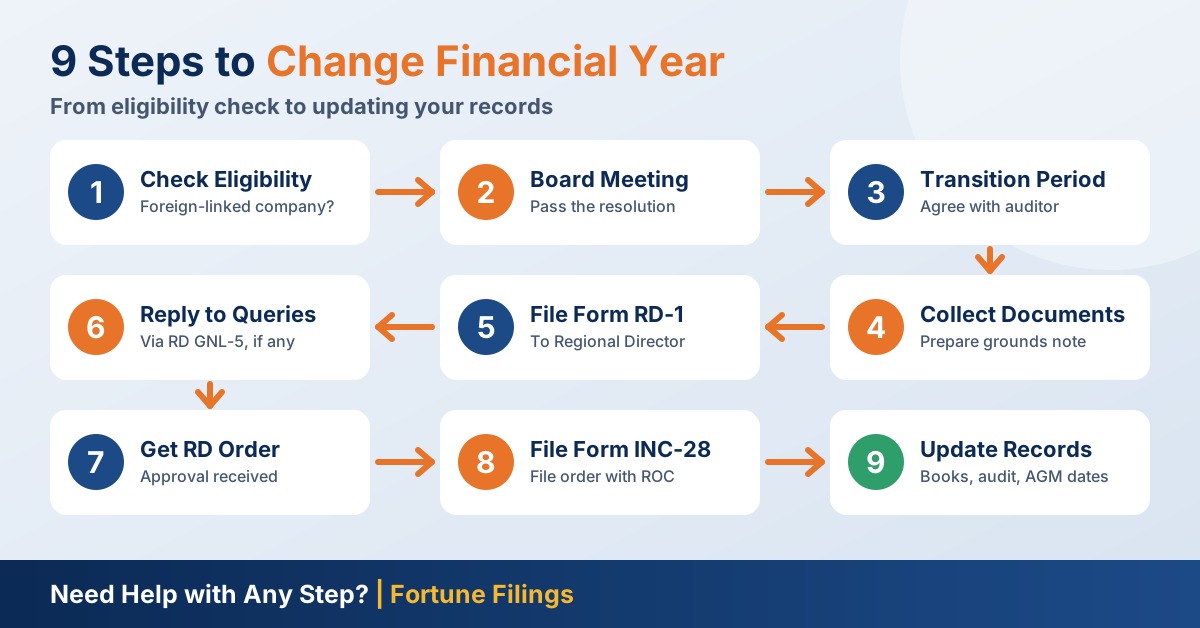
Step 1: Check Eligibility
First confirm that your company is a holding, subsidiary or associate company of a foreign company and that it must follow a different year for consolidation abroad. If it doesn’t qualify, the application will be rejected.
Step 2: Hold a Board Meeting
Call a board meeting and pass a resolution that:
Approves the change in financial year
States the proposed new financial year and the reasons
Authorises a director or officer to file the application with the Regional Director
Record the votes in favour and against, as these details are required in the form.
Step 3: Prepare the Transition Period Details
Decide how the change will work in practice. The period between the current year-end and the new year-end can be shorter or longer than 12 months. For example, a company moving from April-March to January-December may have a nine-month transition period (1 April to 31 December). Your auditor should agree on this period and on how accounts will be prepared for it.
Step 4: Collect and Prepare All Documents
Gather the documents listed above, and prepare the grounds for the application in clear and simple language.
Step 5: File Form RD-1 with the Regional Director
The application is filed online on the MCA portal in e-Form RD-1, addressed to the Regional Director of the region where the company’s registered office is located. The form must be digitally signed, and the prescribed fee paid, as per the Companies (Registration Offices and Fees) Rules, 2014. Attach all the supporting documents.
Step 6: Respond to Queries, If Any
If the Regional Director finds defects or needs more information, the company must resubmit the corrected details through e-Form RD GNL-5. Reply promptly and clearly, since delays can hold up the approval.
Step 7: Receive the Regional Director’s Order
Once satisfied, the Regional Director issues an order allowing the change in the financial year. Read the order carefully, as it states the new financial year and the transition period that has been approved.
Step 8: File Form INC-28 with the ROC
After receiving the order, the company must file Form INC-28 with the Registrar of Companies, attaching the copy of the order. This is generally to be done within 30 days of receiving the order, so that the MCA records are updated.
Step 9: Update Accounts and Compliance Calendars
Once approved, make these changes:
Prepare books and financial statements as per the new financial year
Inform your statutory auditor and plan the audit as per the new cycle
Reset the dates for the AGM, board meetings and ROC filings
Update your internal compliance calendar
Our MCA compliance experts can help you map the new due dates correctly.
Fees and Costs Involved
The total cost depends on:
Government fee for filing Form RD-1, as per the prescribed fee rules
DSC cost, if the authorised director does not have one
Professional fees for drafting the resolution, preparing the application and filing
Auditor’s fees, for any additional work related to the transition period
Fee amounts can change, so confirm the latest schedule on the MCA portal before filing. For a clear quote for your company, contact us here.
Time Taken to Change the Financial Year
If your documents are ready and there are no queries, the approval can take a few weeks, depending on the Regional Director’s office. Queries or missing details can extend this. Want it done faster? The experts at Fortune Filings prepare the application and handle the MCA filing online, so you can focus on your business.
Impact of Changing the Financial Year
Changing the financial year affects more than just the books. Keep these in mind:
Audit and AGM: The auditor’s report, the AGM and the ROC filings will all follow the new year-end.
Transition period accounts: Financial statements for the shorter or longer transition period must be prepared and filed correctly.
Income tax: For Indian income tax, the tax year follows the April to March cycle. A company that follows a different year for company law purposes may need to handle tax reporting separately, so get proper advice from a tax expert. You can read more on our Tax Planning & Advisory page.
GST and other filings: GST returns follow their own monthly or quarterly dates, so these are not affected by the company’s financial year, but your accounting records should be reconciled carefully.
Contracts and reporting: Update lenders, investors and other stakeholders about the new reporting period.

Common Mistakes to Avoid
Assuming any company can change the financial year: Only the eligible foreign-linked companies can apply.
Starting the new year before approval: The change takes effect only after the Regional Director’s order.
Incomplete or unclear grounds in Form RD-1: This leads to queries and delays.
Forgetting to file Form INC-28 after the order: The MCA records remain outdated.
Not informing the auditor early: It can disturb the audit planning for the transition period.
Ignoring tax implications: The company law year and the tax year need to be handled together.
Missing the AGM and filing dates after the change: Leads to late fees.
Compliance Checklist After the Change
Once your new financial year is in place, make sure your company keeps up with its regular filings, such as annual financial statements (AOC-4), the annual return (MGT-7), director KYC, and income tax returns. See our Pvt Ltd Compliance page for the full list of due dates and services. For income tax filing support, you can also check our Income Tax E-filing service.
Why Choose Fortune Filings to Change Your Company’s Financial Year?
Fortune Filings is a trusted corporate services platform in Chennai, serving 1,000+ clients with company registration, MCA compliance and tax filing.
100% online process with no office visits
Expert drafting of the board resolution and Form RD-1 application
Support in replying to Regional Director queries through RD GNL-5
Filing of Form INC-28 after approval
DSC assistance under one roof
Clear pricing with no hidden charges
Quick support through call and WhatsApp
Planning to change your company’s financial year? Contact Fortune Filings today and our experts will guide you through every step.

Frequently Asked Questions (FAQs)
1. Can any company change its financial year in India?
No. Under Section 2(41) of the Companies Act, 2013, companies must follow the 1 April to 31 March year. Only a holding, subsidiary or associate company of a foreign company that needs a different year for consolidating accounts abroad can apply to change it.
2. Who approves the change in a company’s financial year?
The Regional Director (RD) of the region where the company’s registered office is located. Earlier this approval came from the NCLT, but the power now rests with the Regional Director.
3. Which form is used to apply for a change in financial year?
The application is made in e-Form RD-1 on the MCA portal. If the Regional Director raises defects or queries, the company resubmits through e-Form RD GNL-5. After the approval order, Form INC-28 is filed with the ROC.
4. Can a company change its financial year back to April-March?
Yes. A company that was allowed a different financial year can apply to the Regional Director to return to the standard 1 April to 31 March period, following the same process.
5. Does changing the financial year affect income tax filing?
It can. Income tax follows the April to March cycle, so companies using a different year under company law may need to deal with tax reporting separately. It is best to consult a tax professional before applying.
Conclusion
Changing a company’s financial year is not a routine step. It is allowed only for eligible foreign-linked companies and needs approval from the Regional Director through Form RD-1, followed by Form INC-28 filing. With proper planning, a clear board resolution and well-prepared documents, you can complete the process smoothly and avoid delays.
If you need help with the approval, the transition period accounts or the follow-up filings, Fortune Filings is ready to assist. Get in touch here.