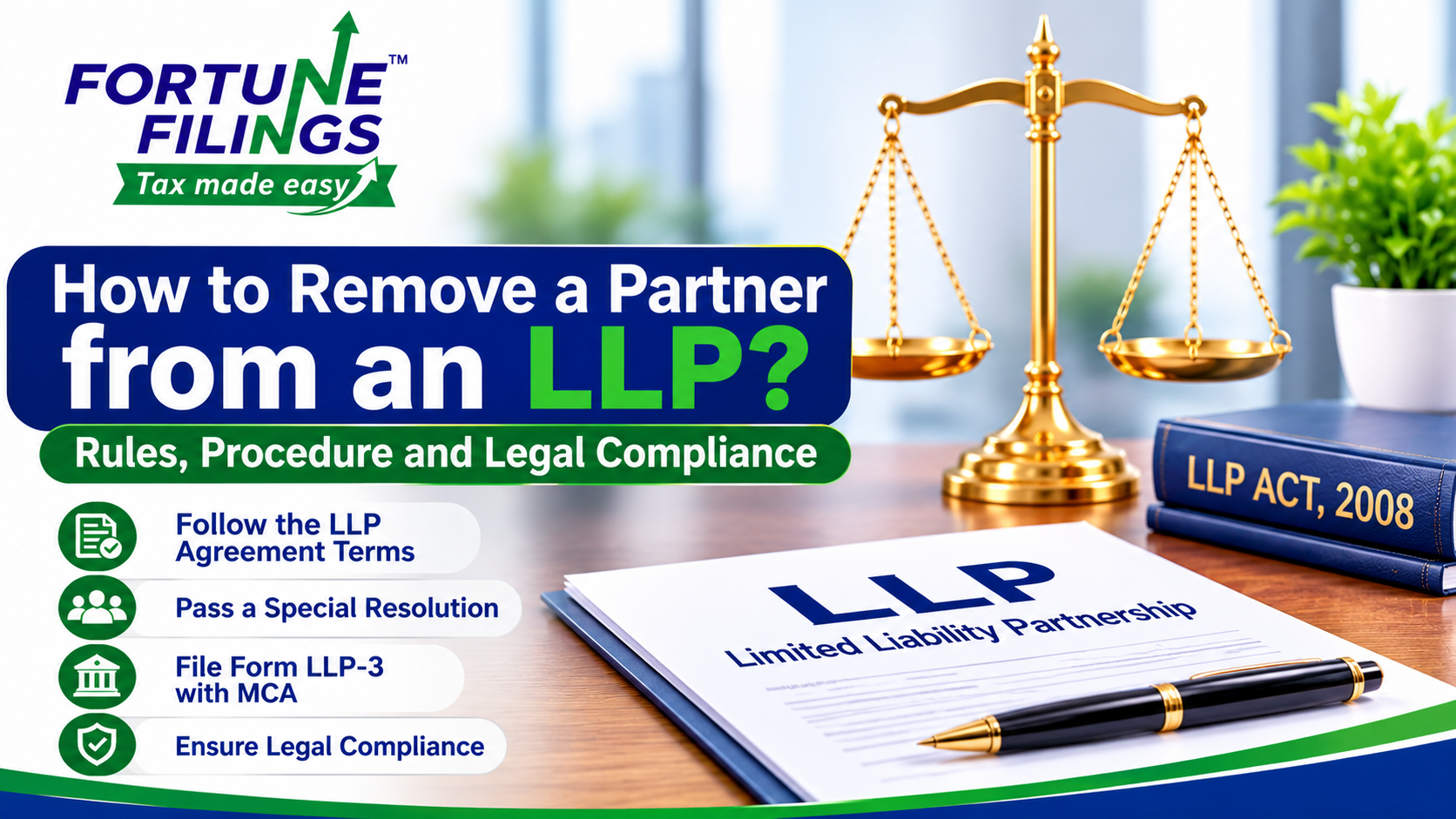
A Limited Liability Partnership (LLP) is popular because it combines the flexibility of a partnership with the protection of limited liability. But partners do not always stay together forever. Business goals change, relationships break down, someone retires, or a partner simply wants to move on. When that happens, the big question is: how to remove a partner from an LLP legally, without disputes and without penalties?
Many LLPs run into trouble here. They make a verbal decision, forget the paperwork, and later face penalties, tax issues or even legal battles. This guide explains the rules, the step-by-step procedure and the compliance requirements, so your LLP can handle a partner’s exit smoothly. If you need professional help at any stage, the experts at Fortune Filings can handle it end to end.
What Does “Removing a Partner from an LLP” Mean?
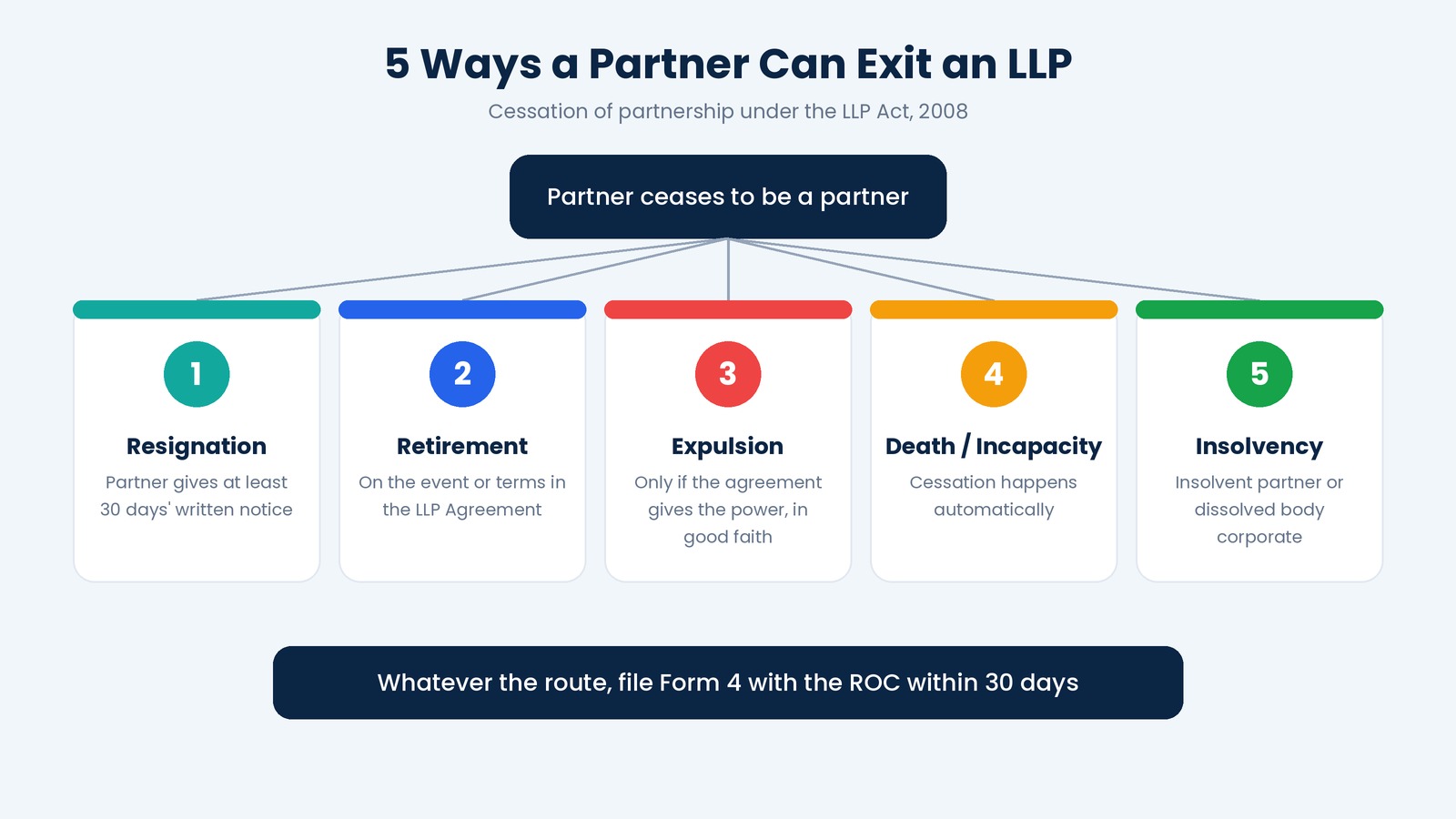
Removing a partner means ending that person’s association with the LLP. Legally, this is called a cessation of partnership. A person can stop being a partner of an LLP in several ways:
Voluntary resignation: the partner decides to leave.
Retirement: the partner exits on an event or terms already mentioned in the LLP Agreement.
Expulsion (removal): the other partners remove the partner as per the powers given in the LLP Agreement.
Death or incapacity: the partner passes away or can no longer act as a partner.
Insolvency or dissolution: the partner becomes insolvent, or a body corporate partner is dissolved.
Whichever route applies, the LLP must record the change with the Registrar of Companies (ROC). The governing law is the Limited Liability Partnership Act, 2008 and the LLP Rules, 2009.
Legal Rules You Must Know Before Removing a Partner
Before you start the process, understand these key rules.
1. The LLP Agreement is the first and most important document
The LLP Act gives huge importance to the LLP Agreement. The rights and duties of partners, and how a partner can exit, are mainly decided by what the agreement says. Always read your agreement first.
2. Expulsion needs a clause in the agreement
A partner cannot be thrown out just because the majority wants it. Under the default provisions of the Act, a partner can be expelled only if the LLP Agreement gives that power, and the power must be used in good faith. If your agreement has no expulsion clause, the exit should happen through mutual consent or resignation.
3. Resignation requires written notice
If the LLP Agreement does not specify how a partner can resign, a partner can leave by giving at least 30 days’ written notice to the other partners.
4. Minimum number of partners
An LLP must always have at least two partners. If the number falls below two and the LLP continues for more than six months, the remaining partner can become personally liable for the LLP’s obligations during that time. So plan a replacement partner before the exit.
5. Designated partner rules
Every LLP must have at least two designated partners, who must be individuals, and at least one of them must be a resident in India. If the exiting partner is a designated partner, you must appoint a new designated partner. They also need a DPIN and a valid digital signature. You can get a Digital Signature Certificate (DSC) and handle DIN-related compliance through professionals.
6. Past liabilities do not disappear
Leaving the LLP does not cancel obligations that arose before the exit. Dues, contractual commitments and liabilities from the period of partnership can still be claimed. This is why a proper settlement agreement matters.
Step-by-Step Procedure to Remove a Partner from an LLP
Here is the practical process most LLPs follow.
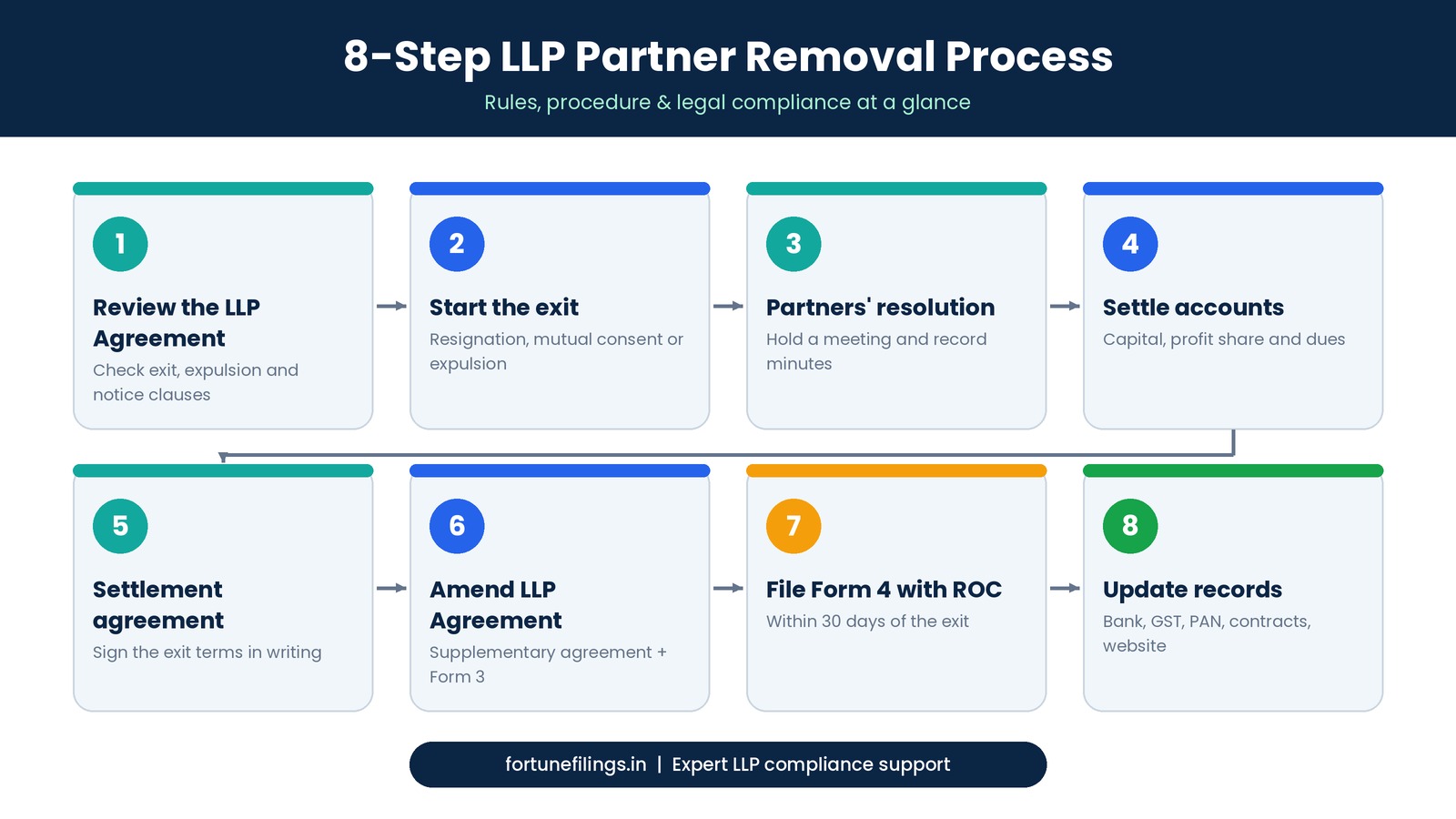
Step 1: Review the LLP Agreement
Check the clauses on resignation, retirement, expulsion, capital refund, profit sharing, notice period and settlement of dues. This tells you which route is legally available.
Step 2: Get the exit started
Resignation: the partner submits a written resignation or notice.
Expulsion: the other partners follow the procedure in the agreement, including giving the partner a fair opportunity to be heard.
Mutual exit: all partners agree on the terms in writing.
Step 3: Hold a partners’ meeting and pass a resolution
Conduct a meeting and pass a resolution approving the cessation, the effective date, and the settlement terms. Keep minutes of the meeting for your records.
Step 4: Settle accounts and capital
Calculate the outgoing partner’s capital contribution, share of profits, loans to or from the LLP, and any other dues. Document how and when this will be paid.
Step 5: Sign a settlement or exit agreement
A written settlement protects both sides. It records the payment, the release from future claims (to the extent agreed), and confidentiality or non-compete terms if any.
Step 6: Amend the LLP Agreement if needed
If the exit changes the agreement (for example, profit-sharing ratios, capital, or partner details), prepare a supplementary LLP Agreement on proper stamp paper and file Form 3 with the ROC within 30 days of the change.
Step 7: File Form 4 with the ROC
Form 4 is the notice of cessation of a partner. It must be filed with the Registrar within 30 days of the partner ceasing to be a partner. The form is generally signed digitally by a designated partner and certified by a professional. If the outgoing partner was a designated partner, a new designated partner’s appointment and consent are filed in the same form.
Step 8: Update other registrations
After the ROC filing, update the partner change with:
Bank accounts and signatories
GST registration (authorised signatory or partner details)
PAN and TAN records if required
Licenses, contracts and trademarks
Letterheads, website and public records
Documents Required for Partner Removal in an LLP
Keep these ready before filing:
Existing LLP Agreement and any earlier amendments
Resignation letter or notice, or the expulsion notice
Resolution of partners approving the exit
Supplementary LLP Agreement (if the agreement is changed)
Settlement or exit agreement
DPIN, PAN and ID/address proof of any new partner or designated partner
Consent of the new partner or designated partner
Digital Signature Certificates of the signing partners
Latest LLP incorporation details (LLPIN)
Timeline and Government Fees
The filing deadline is the most important part:
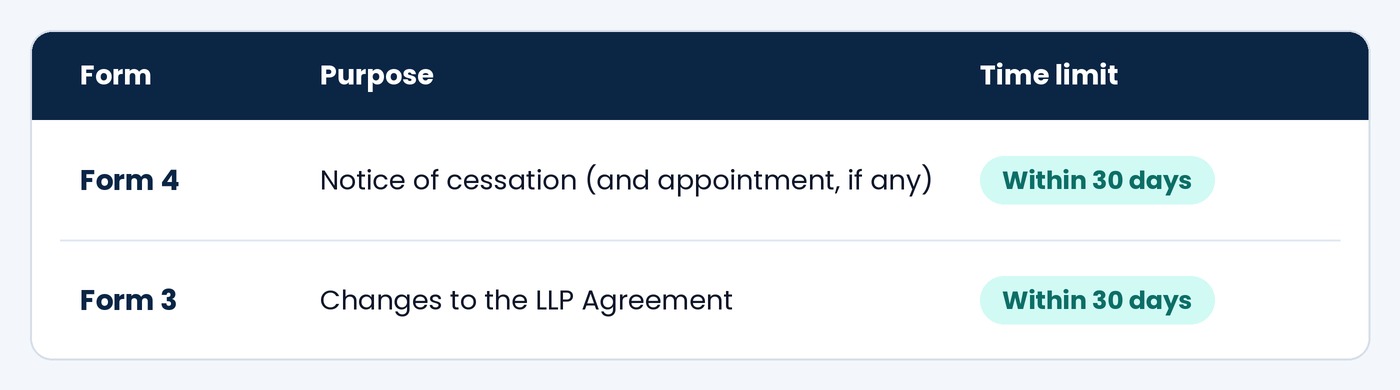
The government fee for these forms is nominal and depends on the LLP’s contribution category. In practice, preparing documents and getting approvals takes a few working days, depending on how ready your paperwork is.
Late filing: If you miss the deadline, the MCA charges additional fees per day of delay, and the amount keeps growing the longer you wait. Late filing can also lead to penalties on the LLP and its designated partners. So never delay the filing.
Compliance Requirements After a Partner Leaves
The exit does not end the paperwork. Keep your LLP in good standing by following these:
Annual filings: continue with Form 11 (Annual Return) and Form 8 (Statement of Account & Solvency) on time. Know the full list in the LLP compliance requirements so nothing is missed.
Income tax: file the LLP’s return and update the partner details in the partnership deed or agreement records.
Maintain minimum partners: ensure at least two partners and two designated partners at all times.
Public notice (where relevant): if an outgoing partner wants protection from future claims, informing third parties and clients about the exit is a smart practice.
Update statutory records: maintain the register of partners and minute books correctly.
If you are setting up a new LLP or restructuring after the exit, you can also explore LLP registration in Chennai with expert support.
What If the Partner Refuses to Leave or the LLP Does Not File Form 4?
Two situations come up often:
1. LLP does not file the notice. If the LLP fails to file the cessation within 30 days, the outgoing partner has the legal option to file the notice with the Registrar on their own. This protects the exiting partner from being shown as a partner in the public records.
2. Disputed removal. If the agreement has no expulsion clause or the process was unfair, the removed partner can challenge the decision. Disputes are normally resolved through the dispute-resolution clause in the agreement, such as arbitration, or through the National Company Law Tribunal (NCLT) or courts. Handling the removal properly from the start is the best way to avoid this.
Common Mistakes to Avoid
Removing a partner verbally without any written record
Expelling a partner when the agreement has no expulsion clause
Forgetting to file Form 4 and Form 3 on time
Not settling the capital and dues in writing
Letting the number of partners fall below two
Leaving the old partner’s name on bank mandates, GST and website
Not appointing a replacement designated partner
Why Choose Professional Help for LLP Partner Removal?
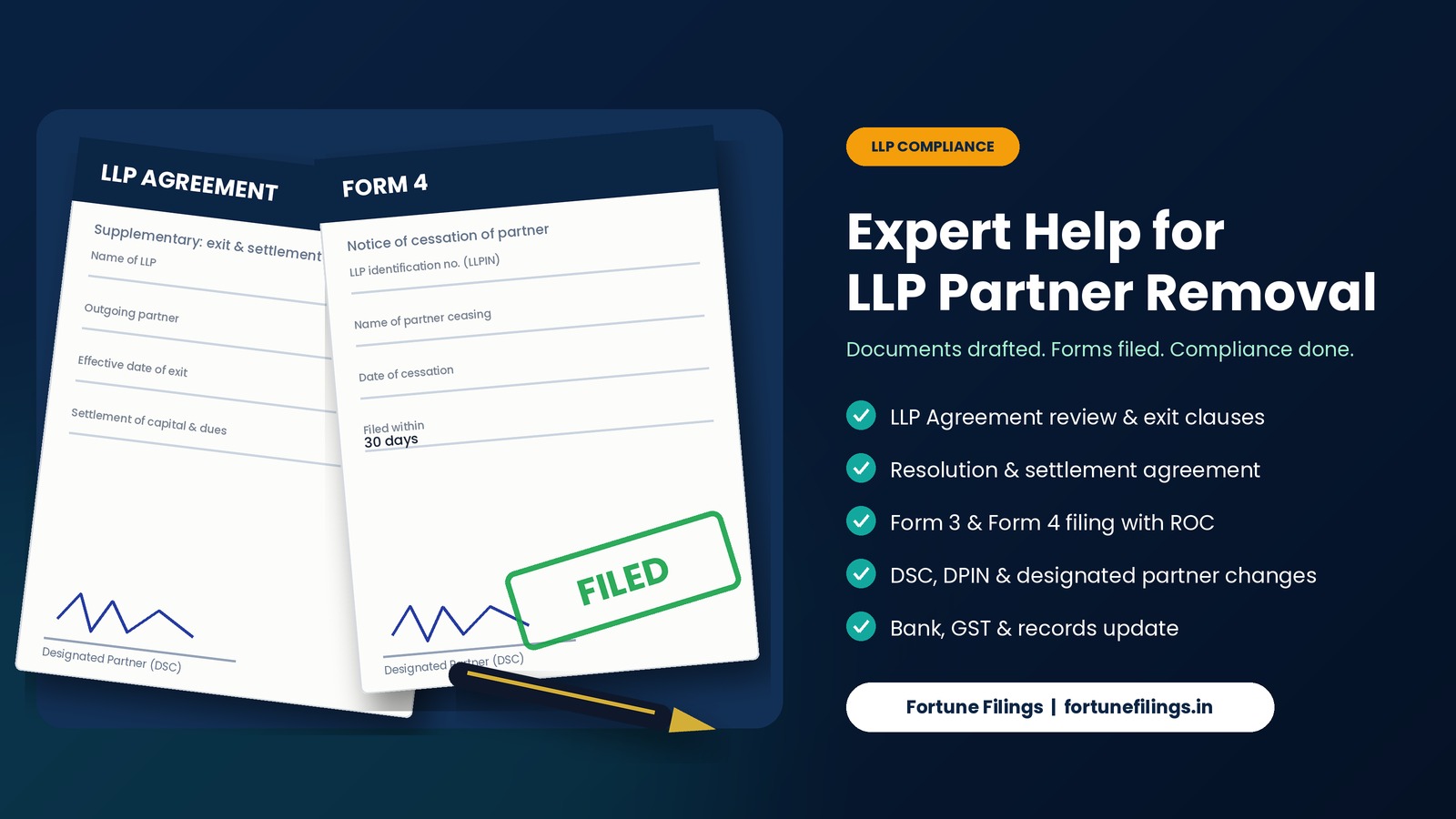
Partner exits can get emotional and legally complex. One wrong clause or one missed deadline can lead to penalties or disputes. A professional team can review your agreement, draft the resolution and settlement, prepare the supplementary agreement, and file Form 3 and Form 4 correctly.
At Fortune Filings, our team of experts supports LLPs across India with partner changes, ROC filings, and ongoing compliance. We make the process 100% online and hassle-free, so you can focus on your business instead of paperwork.
Frequently Asked Questions (FAQs)
1. Can a partner be removed from an LLP without their consent?
Yes, but only if the LLP Agreement contains an expulsion clause and the procedure is followed in good faith. If there is no such clause, a partner cannot be removed against their will and the exit must be through resignation or mutual consent.
2. How many days to file Form 4 after a partner leaves an LLP?
Form 4 must be filed with the Registrar of Companies within 30 days of the date the partner ceases to be a partner. Delay attracts additional fees and penalties.
3. Can an LLP continue with only one partner after a partner resigns?
An LLP must have at least two partners. If it runs with fewer than two for more than six months, the remaining partner can become personally liable for the LLP’s obligations during that period. It is best to admit a new partner quickly.
4. Does a partner remain liable after resigning from an LLP?
The partner is not liable for acts after cessation, but obligations that arose before the exit can still remain. That is why a written settlement agreement and timely filing of Form 4 are important.
5. Is it necessary to amend the LLP Agreement when a partner is removed?
It is required when the exit changes terms of the agreement, such as profit-sharing, capital or partner details. In that case a supplementary agreement is prepared and Form 3 is filed within 30 days.
Conclusion
Removing or accepting the resignation of a partner from an LLP is not just a business decision; it is a legal process. Check your LLP Agreement, follow the right procedure, settle the accounts in writing, and file Form 4 (and Form 3 where needed) within 30 days. Keep your bank, GST and other records updated, and continue your annual compliance without gaps.
Done properly, a partner’s exit can be smooth, fair and fully compliant. Visit Fortune Filings for expert guidance on LLP partner changes and every other registration and compliance need of your business.
Disclaimer: This article is for general information and is not legal advice. Please consult a professional for your specific case.
Contact Us
Need help with partner removal, Form 4 or Form 3 filing, or LLP compliance? Our experts are ready to help.
👉 Contact Us for a quick consultation.
📞 +91 63795 75568
📧 care@fortunefilings.in
📍 No.56, B3, 2nd Floor, Oyester Building, 19th Street, 4th Avenue, Ashok Nagar, Chennai – 600083