Every year, lakhs of taxpayers in Chennai sit down to file their income tax return. Salaried employees in OMR and Guindy, shop owners in T Nagar, freelancers working from home, startup founders and company directors all have one thing in common: they must report their income correctly and on time. The year 2026 is especially important because the tax system is in a transition phase. A new Income Tax Act has been introduced, deadlines have been extended for some categories, and the e-filing portal has been revamped.
In this guide, we explain the key rules, deadlines, forms, documents and common mistakes in simple language, so you can file with confidence. If you prefer expert support, you can also take help for income tax filing in Chennai from start to finish.
What Is Income Tax Return (ITR) Filing?
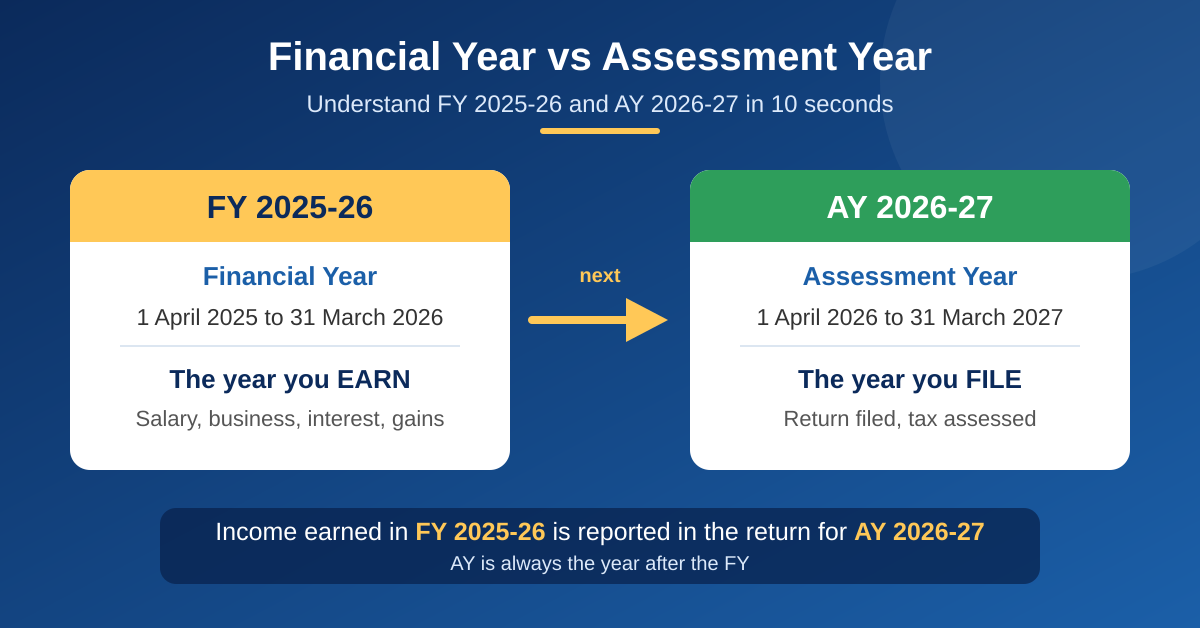
An income tax return, or ITR, is a form in which you declare your income, deductions, investments and taxes already paid during a financial year to the Income Tax Department. For FY 2025-26, the return is filed under Assessment Year (AY) 2026-27.
Filing your return is not only a legal duty. It also helps you:
Pay any balance tax and avoid interest and penalties
Claim a refund if excess tax was deducted
Carry forward losses to future years
Build a clean financial record for loans, credit cards and visas
Respond easily if the department asks for clarification
Who Must File an Income Tax Return in Chennai?
Many people assume ITR is only for those who pay tax. In reality, you may need to file even when your tax payable is zero. You should file a return if you are:
An individual whose total income is above the basic exemption limit of the tax regime you choose
A salaried employee who wants to claim a refund of excess TDS
A freelancer, consultant, doctor, lawyer or other professional with professional income
A business owner, proprietor or partnership firm, whether you earned profit or suffered a loss
A Private Limited Company, One Person Company or LLP, which must file returns every year even with no business activity
An investor with capital gains from shares, mutual funds or property
A person with foreign income or foreign assets
An NRI with income from India, such as rent, interest or capital gains
Even if you are below the limit, filing voluntarily is a smart move because banks and embassies often ask for ITR acknowledgements. If you are unsure whether the rule applies to you, the team at Fortune Filings can review your income and guide you.
Key Rules You Should Know for 2026
1. The old Act still governs this return.
Returns for FY 2025-26 are filed under the Income Tax Act, 1961. The new Income Tax Act, 2025 applies from Tax Year 2026-27 onwards, so it will matter for the next filing cycle. Section numbers you see in current return filing still follow the old Act.
2. You must choose between two tax regimes.
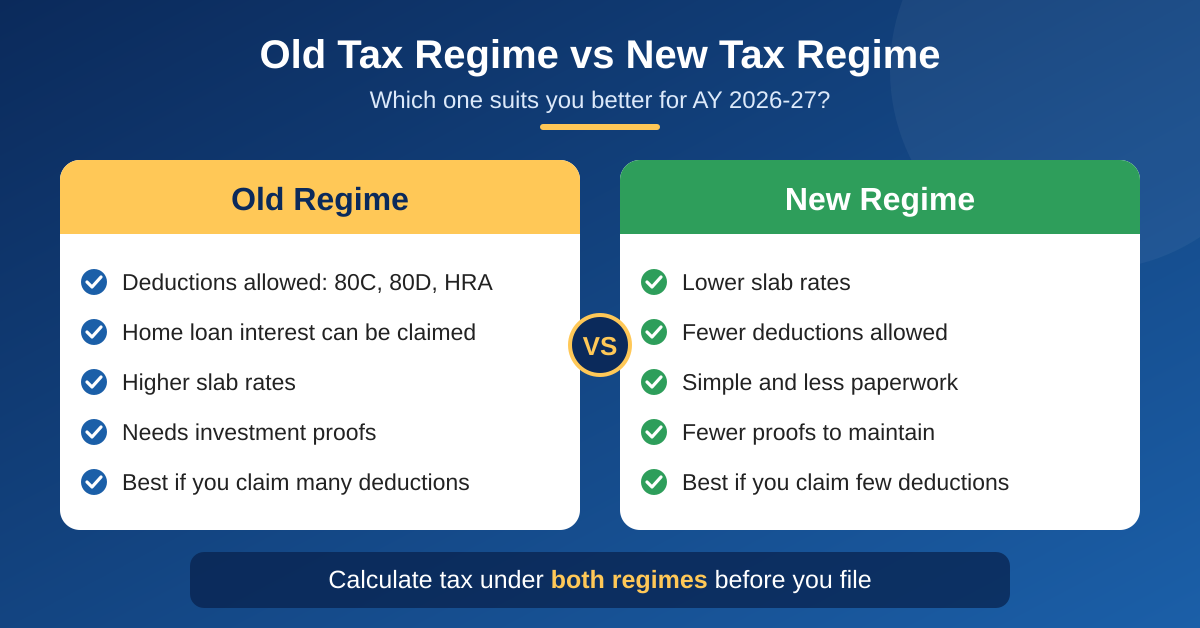
The old regime lets you claim deductions such as Section 80C, 80D, HRA and home loan interest. The new regime offers lower slab rates but allows fewer deductions. The better option depends on your salary structure and investments, so calculate both before you file.
3. Your return should match AIS and Form 26AS.
The department already has data about your TDS, bank interest, dividends, share transactions and other high-value transactions. If your return shows different figures, it may lead to a mismatch notice.
4. E-verification is compulsory.
A return that is submitted but not e-verified is treated as not filed. You can verify using Aadhaar OTP, net banking, a bank account or demat account EVC, or other available methods.
5. Refunds go to a validated bank account.
Make sure your bank account is linked with your PAN and pre-validated on the portal, otherwise your refund may be delayed.
Which ITR Form Should You Use?
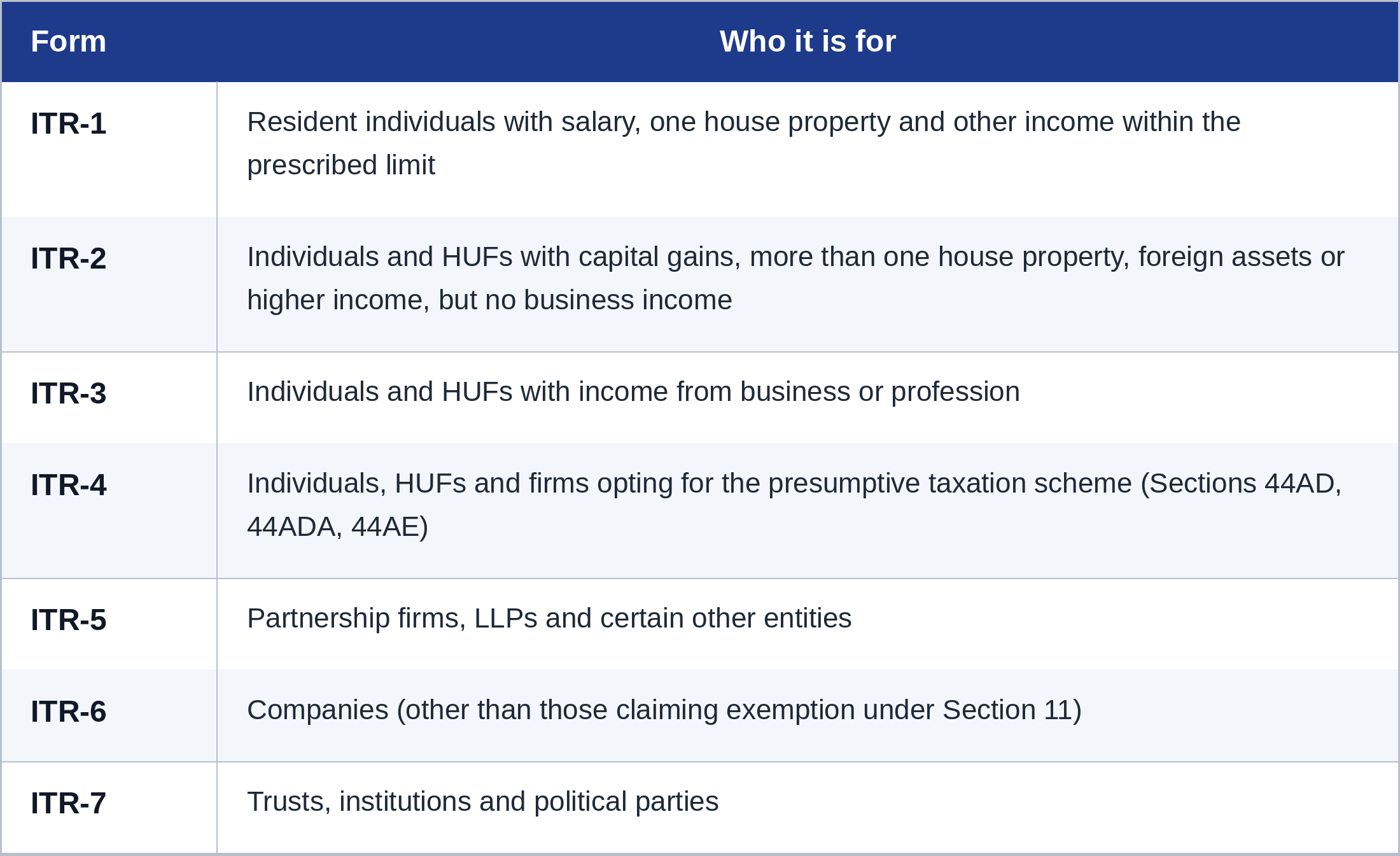
Choosing the wrong form is one of the most common reasons for a defective return notice. Here is a simple guide:
A small mistake in form selection can mean re-filing and delays. If you want a second opinion before submitting, you can consult a team that offers ITR filing services in Chennai and get the correct form chosen from the beginning.
ITR Due Dates for AY 2026-27: Latest Update
Deadlines depend on your category. Here is the current picture:
Salaried individuals and other non-audit taxpayers: 31 July 2026
Non-audit business or professional taxpayers (such as ITR-4 filers): 31 August 2026
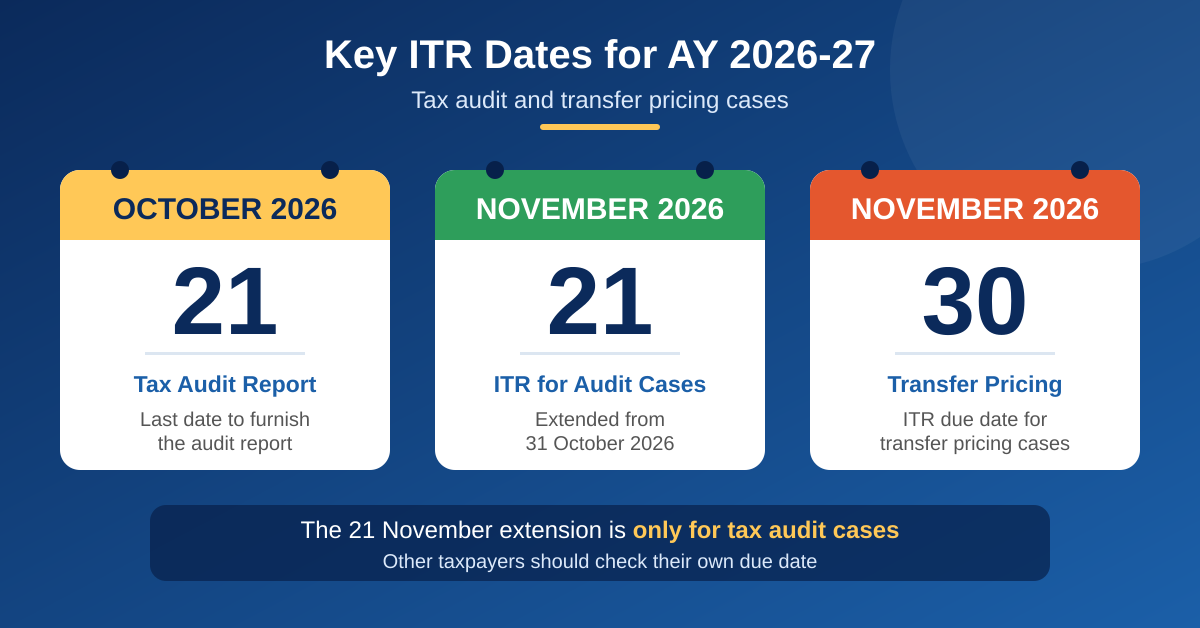
Taxpayers whose accounts require a tax audit: extended from 31 October 2026 to 21 November 2026, and the tax audit report is due by 21 October 2026
Transfer pricing cases: 30 November 2026
The most important update is the extension for audit cases. It was announced in late September 2026 and gives businesses extra time to complete their audit and file their returns. Please remember that this extension is only for audit cases. It is not a blanket extension for all taxpayers, so if your original due date has passed, you will need to follow the belated return route explained below.
If you are a Chennai business owner with audit applicability, start preparing your books now. Do not wait for the last week, because audit, finalisation of accounts and return filing all need time.
Missed the Deadline? Belated and Revised Returns Explained
If you could not file by the original due date, all is not lost.
Belated return: You can generally file a belated return up to 31 December 2026 for AY 2026-27. A late fee under Section 234F applies (up to ₹5,000 depending on your income), and interest under Section 234A is charged on any unpaid tax.
Revised return: If you notice a mistake after filing, such as a missed deduction, wrong income figure or incorrect bank detail, you can file a revised return, generally up to 31 March 2027.
Filing late can also delay your refund and may stop you from carrying forward certain losses. So the best approach is to file early and file correctly.
Documents Required for Income Tax Filing
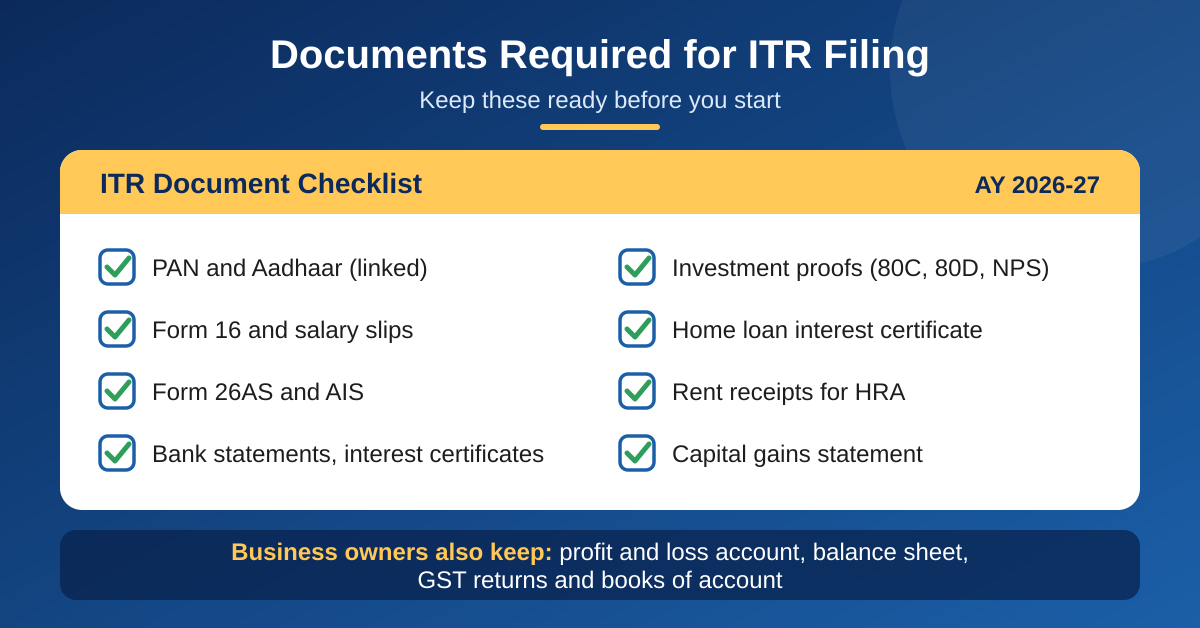
Keeping documents ready is the quickest way to avoid last-minute stress. Collect these before you begin:
PAN card and Aadhaar card (linked to each other)
Form 16 from your employer and salary slips
Form 26AS and Annual Information Statement (AIS)
Bank statements and interest certificates for savings accounts, FDs and RDs
Investment proofs for Section 80C, 80D and NPS
Home loan interest certificate, if applicable
Rent receipts if you claim HRA
Capital gains statements from your broker or demat account
For businesses: profit and loss account, balance sheet, GST returns and books of account
Details of foreign income or foreign assets, if any
Once you share these with a trusted partner like Fortune Filings, the team can prepare, review and file the return for you.
Step-by-Step Process to File Your ITR Online
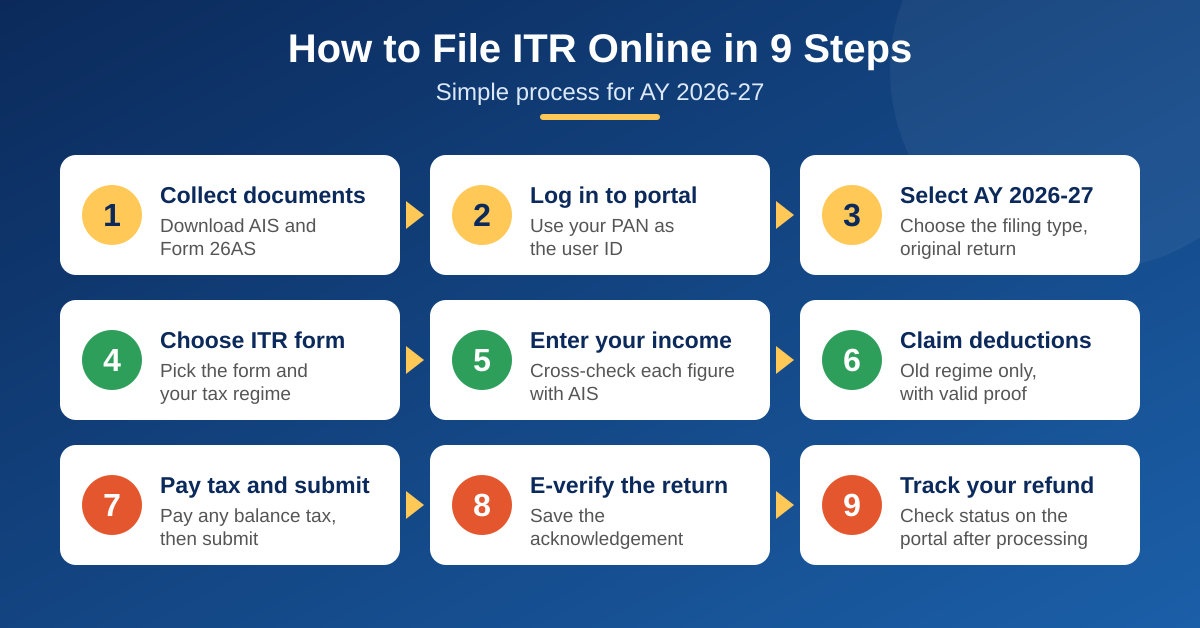
Collect your documents and download your AIS and Form 26AS from the portal.
Log in to the official e-filing portal using your PAN as the user ID.
Select the assessment year (AY 2026-27) and the filing type, such as original return.
Choose the correct ITR form and decide your tax regime.
Enter your income details and cross-check each figure with AIS.
Claim eligible deductions if you are opting for the old regime.
Compute your tax, pay any balance tax and submit the return.
E-verify the return and save the acknowledgement for your records.
Track your refund, if any, on the portal after processing.
Common Mistakes to Avoid While Filing ITR
Many notices come from simple, avoidable errors. Watch out for these:
Using the wrong ITR form
Not reporting interest income, rental income or capital gains
Ignoring mismatches between AIS and your return
Claiming deductions without valid proof
Entering a wrong bank account, or one that is not pre-validated, for refund
Forgetting to e-verify after submitting
Reporting income under the wrong head
Waiting until the last date, when the portal is slow and mistakes are more likely
A small error today can turn into a notice tomorrow. This is why many taxpayers prefer a professional review through income tax return filing in Chennai before the final submission.
What to Do If You Receive an Income Tax Notice
Getting a notice can feel stressful, but not every notice is a penalty. Many are simple intimations, mismatch alerts or requests for clarification. Here is a calm approach:
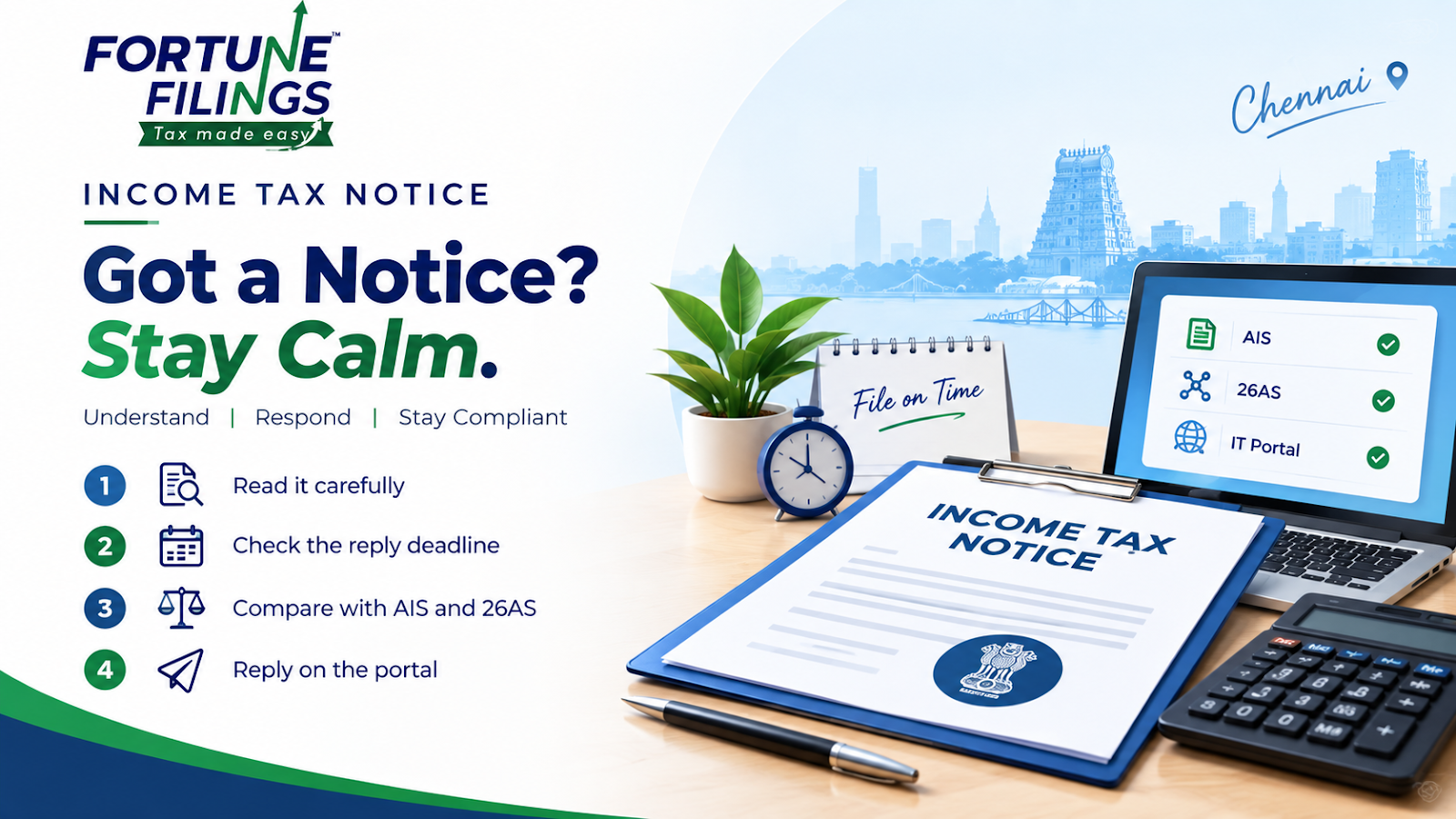
Read the notice carefully and note the section under which it is issued.
Check the response deadline mentioned in it.
Compare the details with your return, AIS and Form 26AS.
Prepare supporting documents such as proofs, bank statements and invoices.
Submit your response on the portal within the time allowed.
Never ignore a notice. If it is complex, get expert help so that your reply is accurate and complete. Handling notices properly through income tax filing services in Chennai can save you from penalties and unnecessary stress.
Why Taxpayers in Chennai Choose Professional Help
Online filing is possible for many people, but professional support makes sense when:
You have more than one source of income, capital gains or foreign assets
You run a business and need books, audit and return filing coordinated
You want to compare the old and new regimes properly and save tax legally
You received a notice and want an accurate response
You simply do not have time to deal with the portal and paperwork
With the right partner, you also get timely reminders for deadlines, advance tax and related compliance such as GST and TDS. It saves time, reduces errors and gives you peace of mind. You can explore the full range of services at Fortune Filings.
Frequently Asked Questions
1. Is ITR filing compulsory for everyone in Chennai?
No. Filing is mandatory if your income crosses the basic exemption limit or you meet other conditions, such as holding foreign assets or making high-value transactions. Many people still file voluntarily to claim refunds and to have proof of income for loans and visas.
2. What is the new due date for audit cases in AY 2026-27?
For taxpayers whose accounts are subject to a tax audit, the due date for filing the return has been extended to 21 November 2026. The tax audit report is due by 21 October 2026.
3. Can I still file my return after the due date has passed?
Yes. You can file a belated return, generally up to 31 December 2026, along with a late fee and interest. Filing sooner reduces the cost.
4. Which is better, the old or the new tax regime?
It depends on your income and deductions. If you claim many deductions such as HRA, Section 80C and home loan interest, the old regime may work better. If you have few deductions, the new regime may be simpler and cheaper. Calculate both before choosing.
5. Where can I get reliable help with income tax filing in Chennai?
You can work with an experienced team such as Fortune Filings, which supports ITR filing, notice handling and related tax and compliance services for individuals and businesses.
Conclusion
Income tax filing in 2026 needs careful attention to the right form, tax regime, documents and deadlines. The new Income Tax Act is on the horizon, the audit-case deadline has moved to 21 November 2026, and the portal keeps evolving, so staying updated matters. File early, match your return with AIS, e-verify on time and avoid the common mistakes listed above to stay clear of penalties and notices. If you need guidance at any step, talk to our team today.