Introduction
Registering a Limited Liability Partnership (LLP) is only the first step in building a legally compliant business. Once an LLP is incorporated, partners must understand their ongoing statutory responsibilities, including maintaining books of accounts, filing annual returns, and determining whether an audit is required. One of the most frequently asked questions by business owners is whether every LLP must undergo a statutory audit. Understanding LLP Audit Requirements Explained helps partners stay compliant while avoiding unnecessary penalties.
Unlike some business structures, not every LLP is required to conduct a mandatory audit each financial year. The audit requirement depends on specific criteria such as annual turnover and partner contribution as prescribed under the Limited Liability Partnership Act, 2008, and the applicable LLP Rules. Knowing these requirements allows businesses to plan their accounting practices, maintain proper financial records, and fulfill compliance obligations efficiently.
Businesses completing LLP Registration in Chennai should understand audit requirements from the beginning because maintaining accurate financial records makes annual compliance significantly easier. Proper accounting practices not only support statutory compliance but also improve financial transparency and strengthen business credibility.
What Is an LLP Audit?
An LLP audit is the examination of an LLP's financial statements, accounting records, and supporting documents by a qualified Chartered Accountant. The purpose of the audit is to verify whether the financial statements present a true and fair view of the LLP's financial position and whether the books of accounts have been maintained in accordance with applicable legal requirements.
An audit also helps identify accounting errors, financial inconsistencies, and compliance gaps before they become significant issues.
Although audits are an important aspect of financial governance, they are mandatory only when an LLP satisfies the prescribed audit criteria.
Why Is an LLP Audit Important?
Even when an audit is not compulsory, maintaining proper accounting records is essential for every LLP.
An audit offers several advantages, including:
Improved financial transparency
Better internal financial controls
Increased business credibility
Easier access to business loans
Greater confidence among partners
Accurate financial reporting
Better tax planning
Reduced compliance risks
Businesses planning future expansion often maintain audited financial statements voluntarily because they improve confidence among banks, investors, and business partners.
Is Audit Mandatory for Every LLP?
No.
One of the biggest misconceptions among entrepreneurs is that every LLP must undergo a statutory audit after incorporation.
In reality, the requirement depends on prescribed financial limits. LLPs that remain below the applicable thresholds may not require a mandatory statutory audit under the LLP Act.
However, even when an audit is not mandatory, LLPs must continue maintaining proper books of accounts and fulfilling annual filing obligations.
Entrepreneurs choosing LLP Registration in Chennai should understand this distinction because annual compliance continues regardless of audit applicability.
When Does an LLP Audit Become Mandatory?
An LLP generally becomes subject to statutory audit when it crosses the limits prescribed under the applicable LLP Rules.
Audit may become applicable based on factors such as:
Annual turnover
Partner contribution
Businesses should periodically review their financial position to determine whether they have crossed the prescribed limits.
Since statutory limits may change through regulatory amendments, LLPs should always follow the latest legal provisions while assessing audit applicability.
Books of Accounts Every LLP Should Maintain
Regardless of whether an audit is required, every LLP should maintain proper accounting records.
Important records generally include:
Cash Book
General Ledger
Sales Register
Purchase Register
Bank Statements
Expense Records
Asset Register
Liability Records
Invoices
Tax Records
Maintaining organized financial records throughout the year makes annual filing and audit significantly easier.
Difference Between Annual Filing and Audit
Many LLP owners assume annual filing and audit are the same. In reality, they are different compliance requirements.
Compliance | Purpose |
Annual Return Filing | Submission of LLP information to the Registrar |
Statement of Account & Solvency | Financial declaration of the LLP |
Audit | Independent examination of financial statements when applicable |
Even LLPs that do not require a statutory audit must generally complete their annual filings within the prescribed timelines.
Businesses unfamiliar with post-incorporation obligations can also refer to LLP Annual Compliance Checklist, which explains the complete compliance schedule after registration.
How an LLP Audit Is Conducted
The audit process generally follows several important stages.
Review of Financial Records
The auditor examines accounting records, vouchers, invoices, receipts, and supporting financial documents.
Verification of Transactions
Business transactions are reviewed to ensure they are properly recorded and supported by documentary evidence.
Examination of Assets and Liabilities
The auditor verifies the LLP's assets, liabilities, receivables, and financial obligations.
Compliance Review
The auditor checks whether statutory requirements relating to accounting and financial reporting have been followed.
Preparation of Audit Report
After completing the examination, the auditor issues an audit report based on the financial statements reviewed.
Common Reasons LLPs Fail Audit Preparation
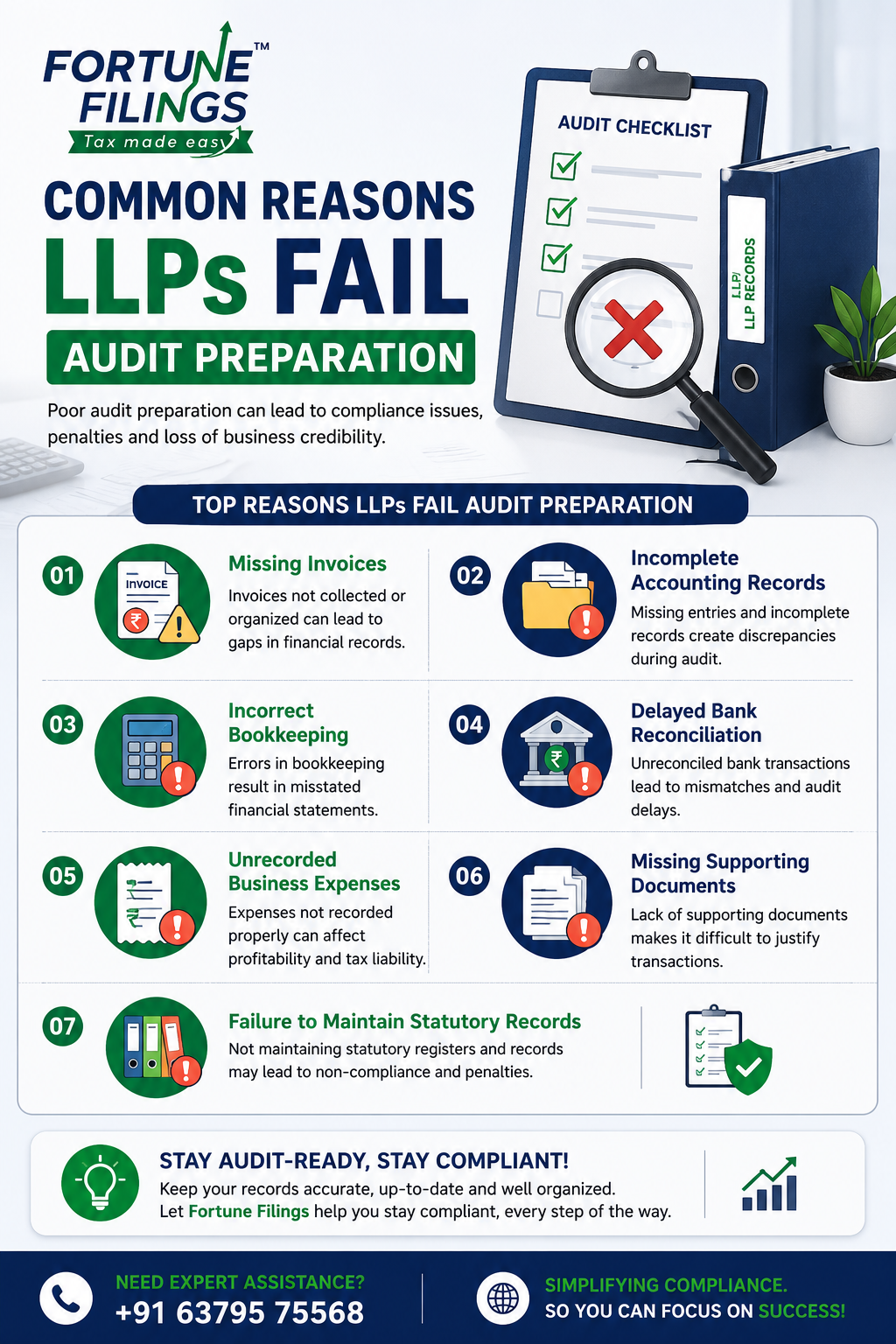
Several businesses struggle during audit because accounting records are not maintained regularly.
Common issues include:
Missing invoices
Incomplete accounting records
Incorrect bookkeeping
Delayed bank reconciliation
Unrecorded business expenses
Missing supporting documents
Failure to maintain statutory records
Maintaining organized documentation throughout the financial year significantly reduces audit difficulties.
Benefits of Maintaining Audited Financial Statements
Even where audit is not mandatory, many LLPs voluntarily maintain audited financial statements.
Advantages include:
Better Loan Approval
Banks often prefer businesses with organized financial statements.
Stronger Business Credibility
Audited accounts improve confidence among suppliers and customers.
Easier Investment Opportunities
Potential investors prefer businesses with transparent financial reporting.
Improved Financial Planning
Audited statements help partners understand business performance more accurately.
Better Decision Making
Reliable financial information supports strategic planning and future expansion.
Audit and Income Tax Compliance
An LLP audit under the LLP Act should not be confused with tax audit requirements under the Income-tax Act.
Depending on the nature of the business and applicable tax laws, an LLP may have separate tax-related compliance obligations.
Businesses should review both corporate compliance and tax compliance independently to ensure complete legal compliance.
Importance of Professional Accounting
Maintaining accurate books of accounts throughout the year makes annual compliance significantly easier.
Professional accounting support helps businesses:
Maintain proper financial records
Prepare financial statements
Complete annual filings
Improve compliance
Reduce accounting errors
Prepare for statutory audits
Businesses with organized accounting systems generally experience fewer compliance issues.
Audit Readiness Checklist
Before the financial year ends, LLPs should ensure they have:
Updated books of accounts
Proper bank reconciliation
Complete purchase records
Sales invoices
Expense vouchers
Fixed asset records
Partner contribution details
Tax payment records
Supporting financial documents
Preparing these records in advance helps simplify the audit process.
Common Compliance Mistakes After LLP Registration
Many LLPs unintentionally create compliance risks by:
Ignoring bookkeeping
Delaying annual filings
Not maintaining accounting records
Misplacing invoices
Failing to review financial statements
Assuming audit is never required
Understanding post-registration responsibilities is equally important as completing incorporation. Businesses can also refer to What Happens If an LLP Does Not File Annual Returns? Penalties Explained to understand how delayed compliance can affect LLP operations.
How LLP Registration Supports Better Compliance
Businesses completing LLP Registration in Chennai often choose this structure because it offers operational flexibility along with a comparatively lower compliance burden than certain other business entities.
However, lower compliance does not eliminate statutory responsibilities. Maintaining proper accounting records, reviewing audit applicability every financial year, and completing annual filings on time help businesses remain legally compliant while supporting sustainable growth.
Why Professional Guidance Matters
Understanding audit requirements can sometimes be challenging, particularly for newly incorporated LLPs and growing businesses. Professional guidance helps ensure that accounting records are maintained correctly, statutory filings are completed on time, and audit obligations are reviewed based on the latest legal provisions.
Businesses that adopt systematic accounting practices from the beginning generally find annual compliance more efficient and are better prepared for future expansion, funding opportunities, and financial planning.
Conclusion
Understanding LLP Audit Requirements Explained is essential for every LLP, regardless of its size or stage of growth. While not every LLP is required to undergo a statutory audit, every LLP must maintain proper books of accounts and fulfill its annual compliance obligations. Reviewing audit applicability based on turnover and partner contribution, keeping accurate financial records, and completing statutory filings on time help businesses remain compliant and avoid unnecessary legal complications.
For entrepreneurs planning or completing LLP Registration in Chennai, establishing strong accounting and compliance practices from the beginning creates a solid foundation for long-term business success. By maintaining financial transparency and staying updated with applicable legal requirements, LLPs can focus on sustainable growth while meeting their statutory responsibilities with confidence.