Introduction
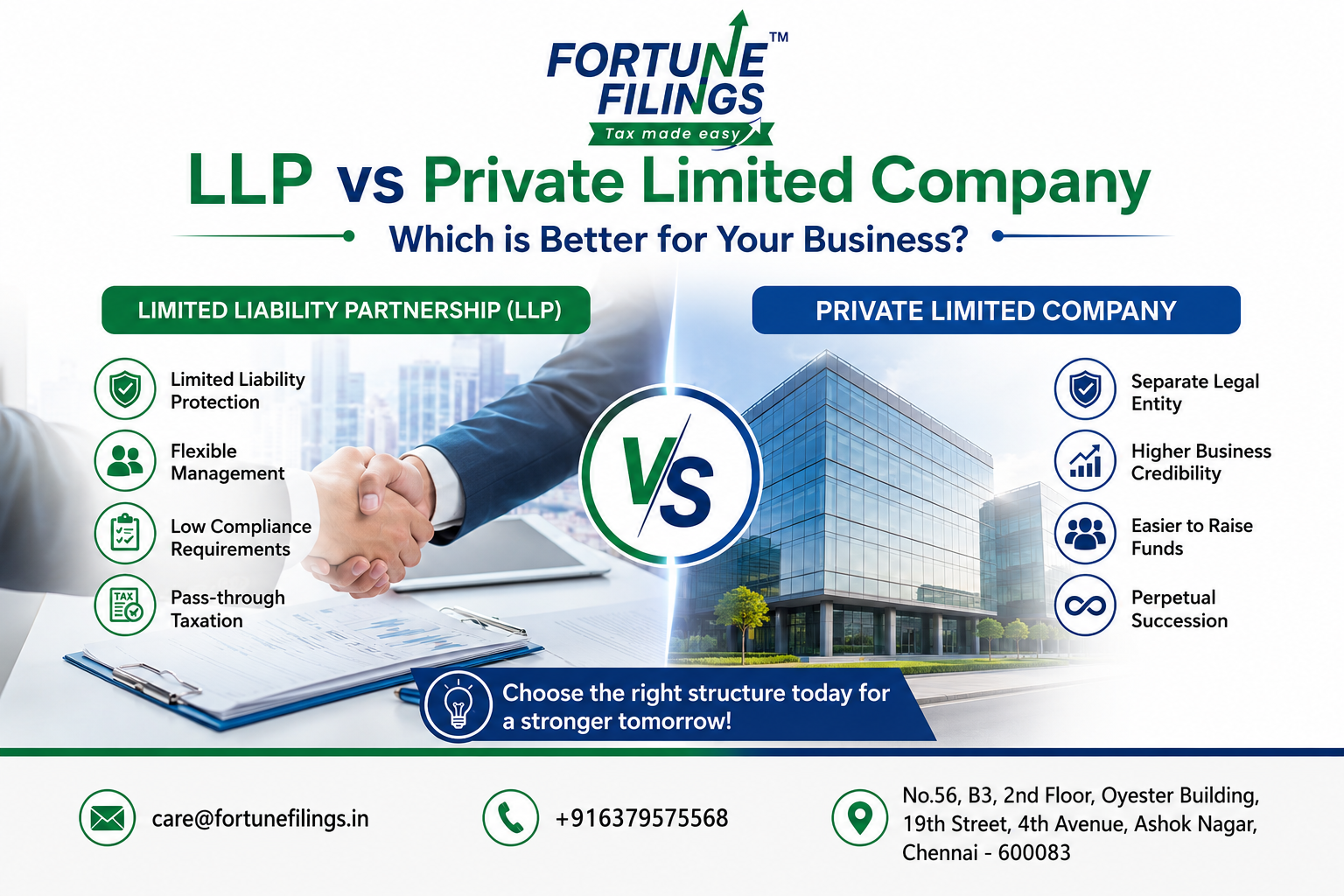
Understanding the difference between LLP vs Private Limited Company is important for entrepreneurs planning to start a business in India. Choosing the right business structure affects taxation, compliance, funding opportunities, ownership flexibility, and long-term business growth.
Many startups and small businesses struggle to decide whether to register as a Limited Liability Partnership (LLP) or a Private Limited Company. Both structures offer limited liability protection and legal recognition, but they differ significantly in compliance requirements, scalability, and investment opportunities.
The right choice depends on your business goals, budget, future expansion plans, and operational requirements. Startups looking for external funding may prefer a Private Limited Company, while professionals and small businesses may find LLP more flexible and cost-effective.
This guide explains the major differences between LLP and Private Limited Company in simple terms.
Confused Between LLP and Private Limited Company?
Choosing the wrong business structure can lead to:
-
Higher compliance costs
-
Difficulty raising funds
-
Tax complications
-
Limited business scalability
Understanding the advantages and limitations of both structures helps entrepreneurs make the right business decision from the beginning.
Quick Summary - LLP vs Private Limited Company
-
LLP has lower compliance requirements
-
Private Limited Company is better for funding
-
LLP is ideal for professionals and small businesses
-
Pvt Ltd offers better scalability
-
Both provide limited liability protection
-
Private Limited Company has stricter compliance
What is an LLP?
A Limited Liability Partnership (LLP) is a business structure that combines the flexibility of a partnership firm with the limited liability protection of a company.
An LLP:
-
Has separate legal identity
-
Protects partners from personal liability
-
Requires fewer compliances
-
Offers operational flexibility
LLPs are commonly preferred by:
-
Consultants
-
Freelancers
-
Small service businesses
-
Professional firms
What is a Private Limited Company?
A Private Limited Company is a legally registered company governed under the Companies Act, 2013.
A Private Limited Company:
-
Has shareholders and directors
-
Can raise external funding
-
Provides separate legal identity
-
Supports business scalability
This structure is widely used by:
-
Startups
-
Technology companies
-
E-commerce businesses
-
Growth-oriented enterprises
LLP vs Private Limited Company – Major Differences
1. Legal Structure
LLP
An LLP operates as a partnership-based business entity where partners manage business operations.
Private Limited Company
A Private Limited Company operates through directors and shareholders under a structured corporate framework.
Private Limited Companies generally have stricter governance compared to LLPs.
2. Compliance Requirements
LLP
LLPs have lower annual compliance requirements.
Basic compliances include:
-
Annual filing
-
Income tax return
-
LLP statement filing
Private Limited Company
Private Limited Companies have higher compliance obligations including:
-
Board meetings
-
Annual ROC filing
-
Financial statements
-
Audit compliance
Businesses looking for lower compliance often prefer LLP registration.
3. Funding and Investment Opportunities
LLP
LLPs face limitations in raising external investments.
Investors usually avoid LLP structures because ownership transfer and investment participation are less flexible.
Private Limited Company
Private Limited Companies can easily raise funds through:
-
Angel investors
-
Venture capital
-
Equity shares
-
Startup funding
This makes Private Limited Companies ideal for startups aiming for rapid growth.
4. Ownership Structure
LLP
Ownership is held by partners.
The rights and responsibilities are governed through an LLP agreement.
Private Limited Company
Ownership is divided into shares held by shareholders.
This structure allows easy transfer of ownership and investment participation.
5. Compliance Cost
LLP
LLPs generally have:
-
Lower registration cost
-
Lower annual maintenance cost
-
Reduced compliance expenses
Private Limited Company
Private Limited Companies involve:
-
Higher compliance cost
-
ROC filing expenses
-
Audit and secretarial compliance
Businesses with smaller budgets often choose LLP.
6. Business Scalability
LLP
LLPs are suitable for:
-
Small businesses
-
Professional services
-
Family-run operations
Scaling large investment-driven businesses through LLP can be difficult.
Private Limited Company
Private Limited Companies are built for:
-
Startup growth
-
Large-scale operations
-
Investor participation
-
Corporate expansion
This structure supports long-term business scalability.
7. Transferability
LLP
Transfer of ownership in LLP is comparatively complex and depends on partner approval.
Private Limited Company
Shares can be transferred easily, making ownership restructuring simpler.
This flexibility attracts investors and business buyers.
8. Taxation Difference
LLP
LLPs are taxed at a flat rate and generally avoid dividend distribution tax complexities.
Private Limited Company
Private Limited Companies follow corporate taxation rules and may involve additional taxation considerations depending on profit distribution.
Tax planning requirements vary based on business operations.
LLP vs Private Limited Company – Comparison Table
|
Feature |
LLP |
Private Limited Company |
|
Legal Identity |
Yes |
Yes |
|
Limited Liability |
Yes |
Yes |
|
Compliance Level |
Low |
High |
|
Funding Opportunity |
Limited |
High |
|
Ownership Transfer |
Moderate |
Easy |
|
Suitable For |
Small Businesses |
Startups & Growth Businesses |
|
Annual Compliance Cost |
Lower |
Higher |
|
Investor Preference |
Low |
High |
Which is Better for Startups?
Choose LLP If:
-
You want lower compliance
-
Business is service-oriented
-
External funding is not a priority
-
You prefer operational flexibility
Choose Private Limited Company If:
-
You plan to raise investment
-
You want rapid business expansion
-
You need strong business credibility
-
Startup scalability is important
Many startups in India prefer Private Limited Company registration because investors generally prefer corporate structures.
Documents Required for LLP and Private Limited Company
Common documents include:
-
PAN Card
-
Aadhaar Card
-
Passport-size photo
-
Address proof
-
Office address proof
-
Digital Signature Certificate (DSC)
Private Limited Companies may require additional incorporation documentation.
You can also read:
LLP vs Private Limited Company for Businesses in Chennai
Businesses in Chennai choose LLP or Private Limited Company based on:
-
Business goals
-
Funding requirements
-
Compliance budget
-
Industry type
Professional company registration consultants Chennai help entrepreneurs:
-
Choose the right structure
-
Prepare documentation
-
Complete MCA filing
-
Ensure legal compliance
Selecting the correct structure helps businesses avoid future operational and financial complications.
Conclusion
Understanding LLP vs Private Limited Company helps entrepreneurs choose the right business structure based on compliance needs, funding goals, scalability, and operational flexibility.
LLP is ideal for professionals, consultants, and small businesses looking for lower compliance and operational simplicity. On the other hand, Private Limited Company registration is better suited for startups and businesses planning large-scale growth and investor participation.
Selecting the right business structure at the beginning can significantly impact long-term business success, financial management, and expansion opportunities.