You are starting alone. No co-founder, no partner, just you and an idea. It could be a freelance design studio in Velachery, a SaaS tool built from Anna Nagar, a trading business in Parrys, or a consulting practice in Adyar. The first legal question is always the same: should I register a One Person Company (OPC) or a Private Limited Company?
Both give you limited liability and a separate legal identity. But they are built for different journeys. This guide explains the difference in simple language so you can decide with confidence.
Quick Answer
Choose an OPC if you are a genuinely solo founder, want a company structure with lighter compliance, and do not plan to bring in investors or co-founders soon.
Choose a Private Limited Company if you plan to raise funding, add co-founders, offer ESOPs, or apply for Startup India recognition.
Short on time? Talk to our Chennai company registration experts.
What Is a One Person Company (OPC)?
An OPC is a company with only one member (shareholder). It was introduced by the Companies Act, 2013 so that a solo entrepreneur could enjoy the benefits of a company without needing a partner.
Key features:
Only one member and at least one director (the member can also be the director)
A nominee must be named, who steps in if the member dies or becomes incapacitated
Separate legal entity with limited liability
No minimum capital requirement
Name ends with “(OPC) Private Limited”
No requirement to hold an Annual General Meeting (AGM)
Learn how we register it online in our One Person Company registration service.
What Is a Private Limited Company?
A Private Limited Company needs at least 2 shareholders and 2 directors and can have up to 200 shareholders. It is the most popular structure for startups and growing businesses in India because raising money and issuing shares is simple.
See how we handle it end to end with our Private Limited Company registration in Chennai service.
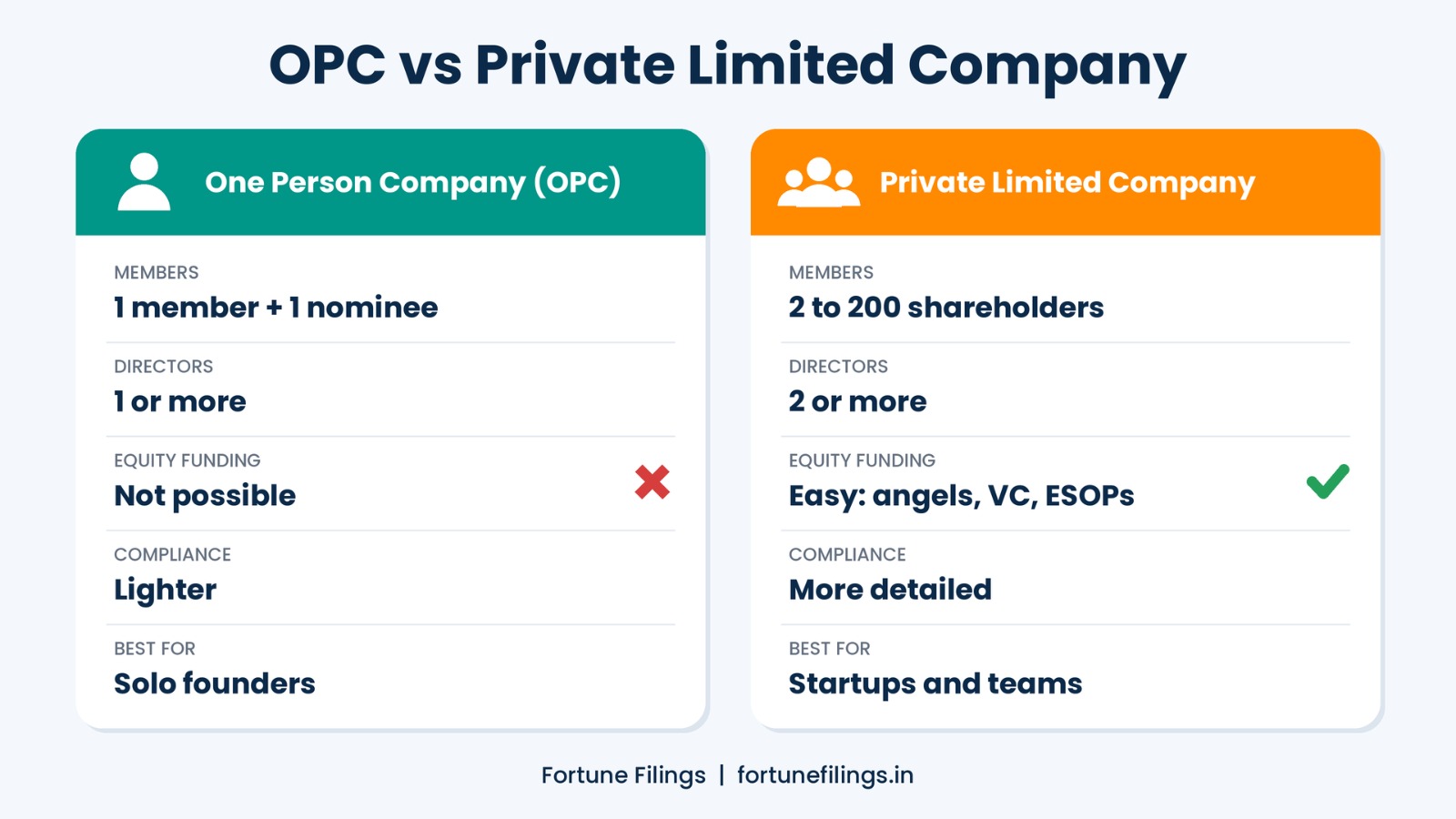
OPC vs Private Limited Company: Side-by-Side Comparison
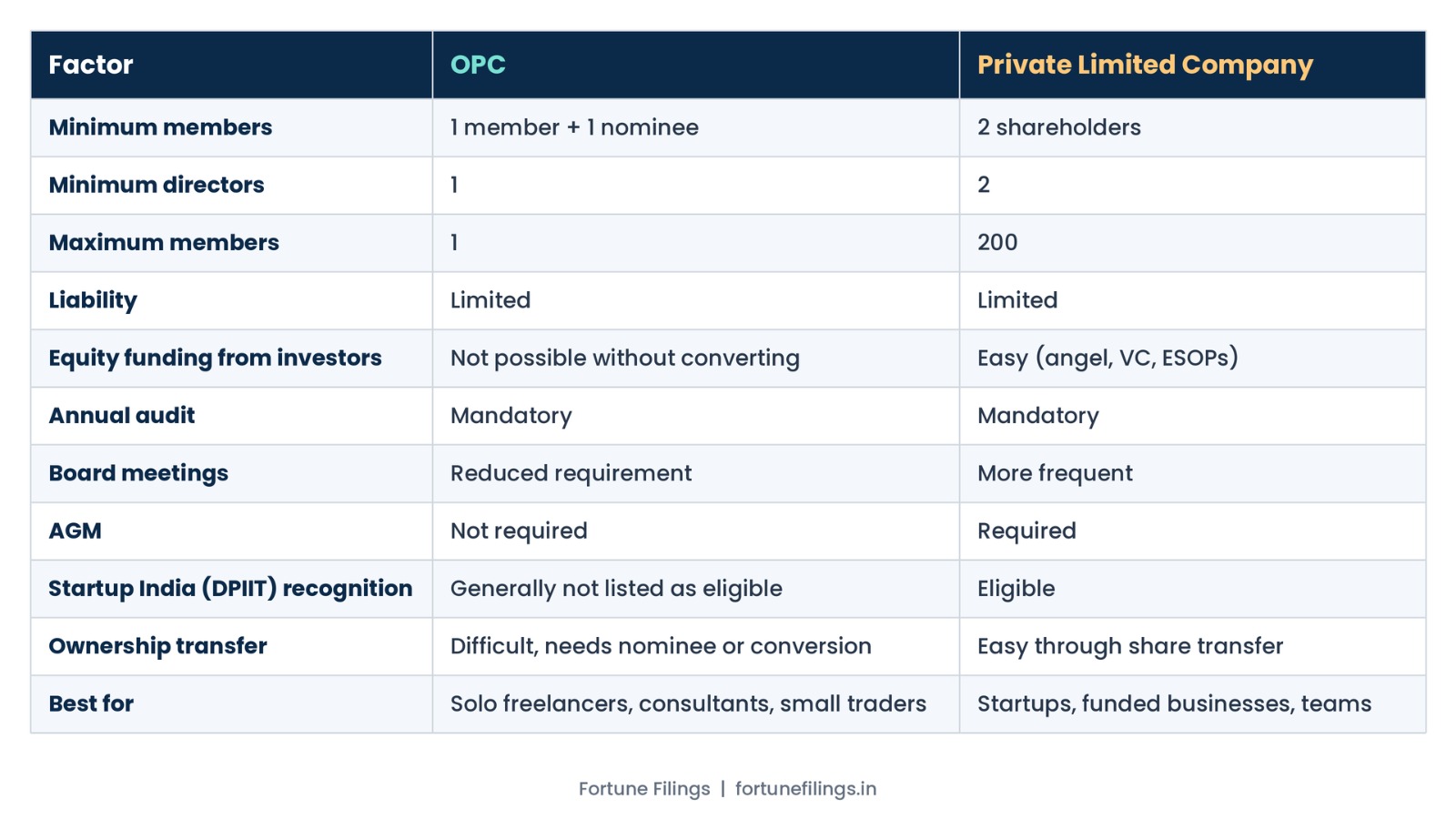
1. Compliance and Cost of Running
An OPC has lighter compliance. You do not need an AGM, and the board meeting requirement is reduced. For a solo founder who wants to stay focused on work, this saves time and money. See the details in our OPC compliance guide.
But do not mistake “lighter” for “none”. An OPC still needs an annual audit, ROC filings and income tax returns. Missing them leads to penalties, just like in a Pvt Ltd. A Private Limited Company has more to maintain: more board meetings, an AGM and more statutory records. Our Pvt Ltd compliance service takes care of all of it so you never miss a due date.
Winner for lower compliance: OPC
2. Funding and Growth
This is the biggest difference between the two.
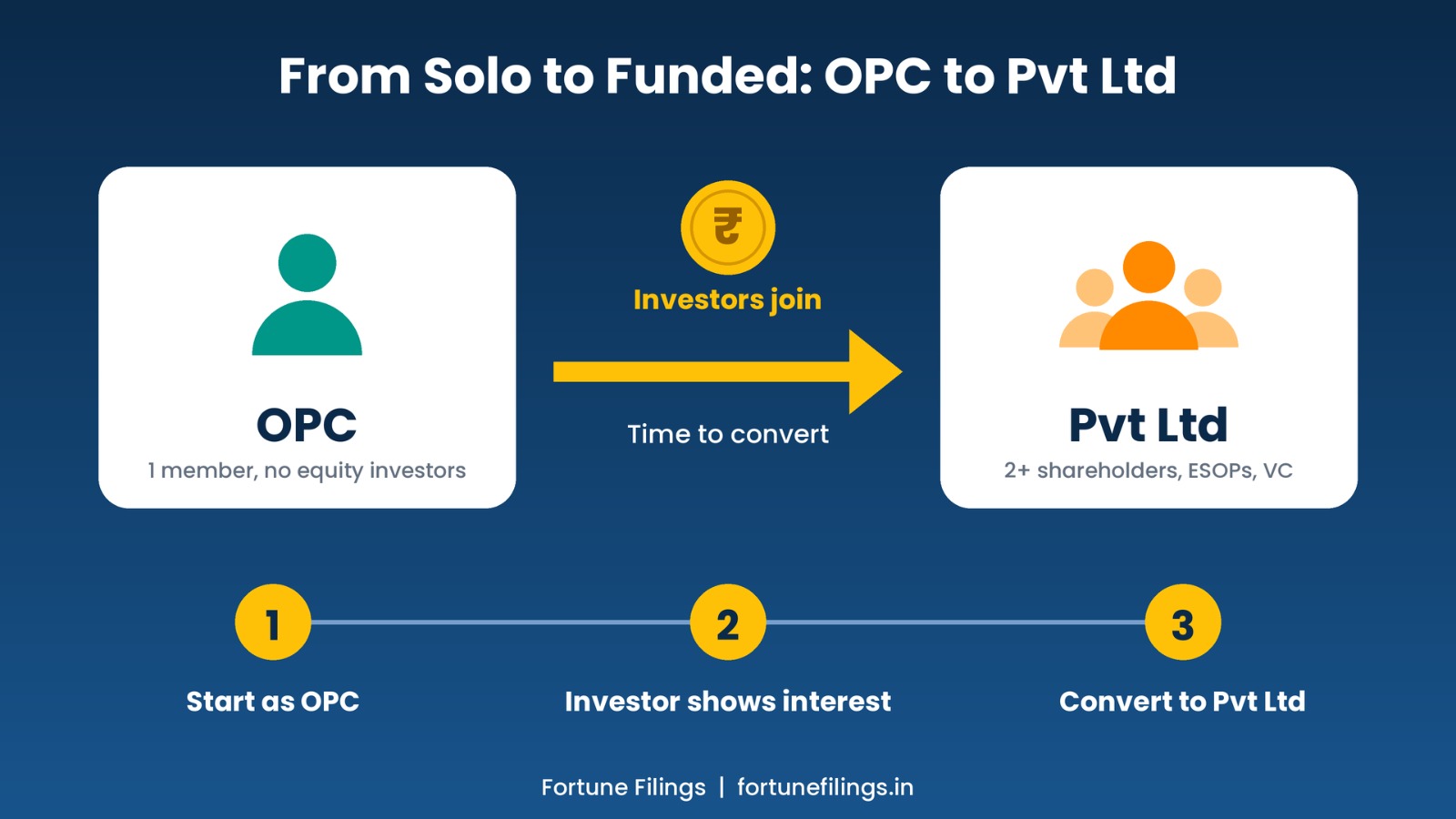
An OPC has a single shareholder, so it cannot take equity investment from angels, VCs or friends. If an investor wants shares, you must first convert to a Private Limited Company. A Private Limited Company can issue shares, create an ESOP pool and bring in new investors easily.
Read more in our guide: Can a Private Limited Company Raise Funding Easily?
Winner for funding: Private Limited Company
3. Startup India Recognition
Many Chennai founders want Startup India (DPIIT) recognition for tax benefits, easier funding and government schemes. The entity types generally listed as eligible are Private Limited Companies, LLPs and registered partnership firms. An OPC is generally not listed, so if Startup India is part of your plan, a Private Limited Company is the safer starting point.
Want DPIIT recognition? Check our Startup India registration service for the full process.
Winner for Startup India: Private Limited Company
4. Control and Decision-Making
As the sole member of an OPC, you take every decision yourself. There is no shareholder to convince and no partner to disagree with. In a Private Limited Company, decisions go through the board and shareholders, which can slow things down if you have co-founders.
Winner for full control: OPC
5. Taxation
Both are companies, so both are taxed at the company level, and in most cases the same corporate tax regime applies. The practical difference is not the rate, it is how you take money out: salary, director remuneration or dividends. A good plan saves real money. Talk to us about tax planning and advisory.
Winner: Equal, depends on your planning
6. Credibility with Banks, Clients and Vendors
Both are registered companies, so both look more professional than a proprietorship. A Private Limited Company usually has stronger acceptance with large clients, tenders and investors. An OPC is well respected for small and medium contracts.
7. Converting Later
You can convert an OPC into a Private Limited Company when you want to bring in investors or co-founders. It needs extra filings and cost. If you already know you will take investment in the next 1-2 years, it is simpler to start as a Private Limited Company and add a family member or trusted person as the second shareholder.
Which Structure Suits Which Chennai Solo Founder?
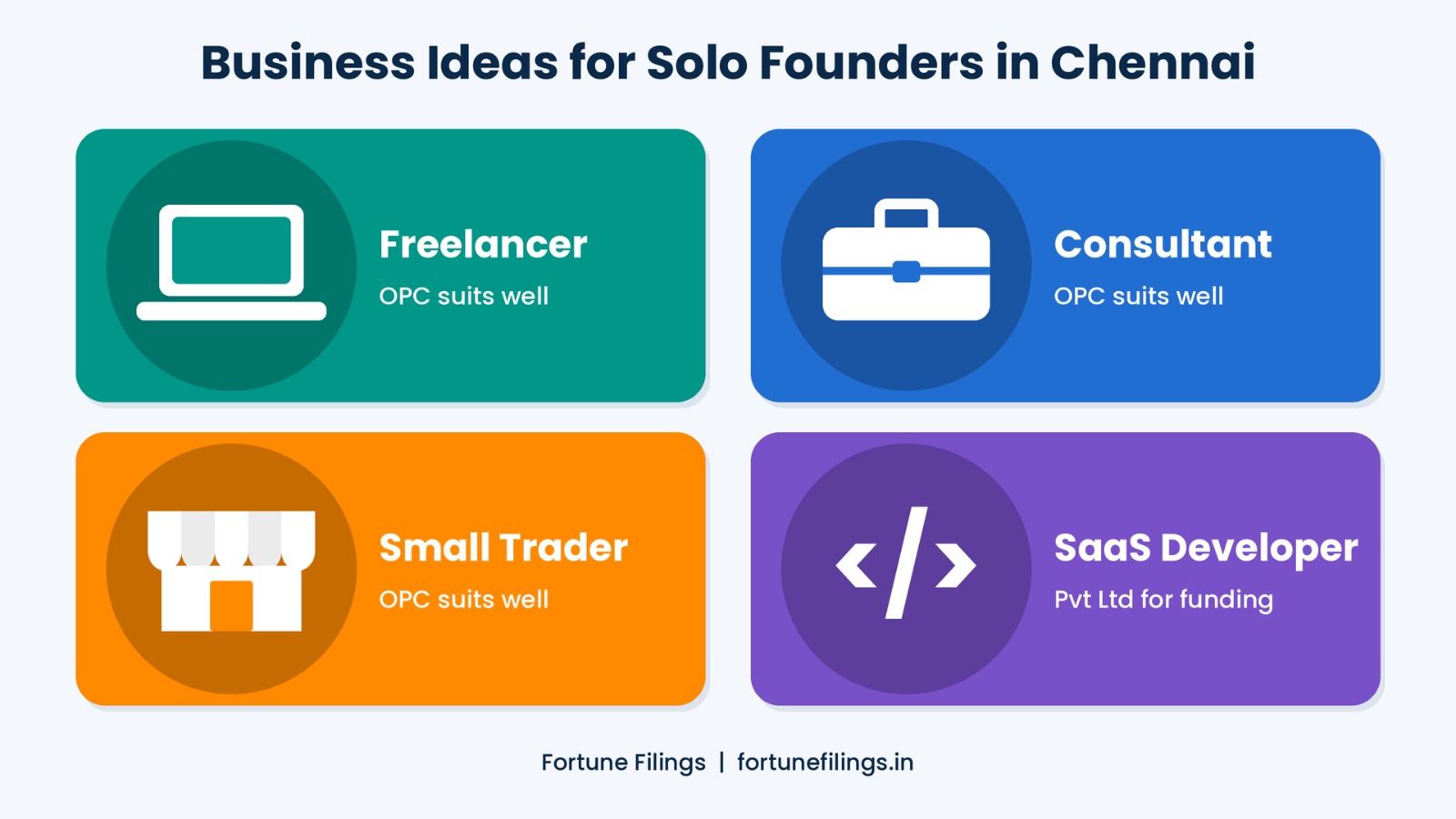
Solo Founder Type | Best Choice | Why |
|---|---|---|
Freelancer or consultant | OPC | Low compliance, full control |
Small trader or retailer | OPC | Simple structure, limited liability |
Home-based service business | OPC | Easy to run alone |
SaaS or app developer planning funding | Pvt Ltd | Equity, ESOPs, Startup India |
Founder with a family member as co-owner | Pvt Ltd | Two shareholders available |
Existing proprietor wanting growth | OPC or Pvt Ltd | Depends on your funding plan |
Already running as a proprietor? Explore our Proprietorship registration and decide whether it is time to upgrade.
Documents Required
PAN and Aadhaar of the director(s) and member
Passport-size photograph and address proof (bank statement or utility bill)
Registered office proof: rent agreement with the owner’s NOC, plus a recent EB or water bill
Nominee consent form (OPC only)
Digital Signature Certificate (DSC) and DIN
Step-by-Step Registration Process
Choose the structure and finalise your company name
Get a DSC for the director(s)
Apply for name approval
File the incorporation forms with MCA
Receive the Certificate of Incorporation, PAN and TAN
Open a current bank account
Apply for GST registration in Chennai and Udyam registration if needed
Common Mistakes Solo Founders Make
Choosing an OPC when investors are already part of the plan
Forgetting to appoint a nominee or not getting the nominee’s consent
Assuming “lighter compliance” means “no compliance”
Skipping annual filings and paying heavy late fees
Choosing a company name that MCA rejects
Our Recommendation
Solo, bootstrapped, low compliance: go with an OPC.
Funding, co-founders, ESOPs or Startup India in your plan: go with a Private Limited Company.
Not sure? Pick the structure that fits where your business will be in 2 years, not just today.
Frequently Asked Questions
1. Can a solo founder register a Private Limited Company?
A Private Limited Company needs at least two shareholders and two directors. A solo founder can add a family member or a trusted person as the second shareholder and director. If you want to stay completely alone, an OPC is the structure designed for you.
2. Can I raise funding in an OPC?
Not directly. An OPC has only one shareholder, so investors cannot hold shares in it. You would need to convert it into a Private Limited Company first.
3. Is an audit mandatory for an OPC?
Yes. Like other companies, an OPC needs a statutory audit and annual filings with the Registrar of Companies, even though the overall compliance is lighter than a Pvt Ltd.
4. Is an OPC eligible for Startup India recognition?
Startup India (DPIIT) recognition is generally given to Private Limited Companies, LLPs and registered partnership firms. An OPC is generally not listed, so it is usually converted to a Private Limited Company first.
5. How long does registration take and what does it cost?
Incorporation typically takes 5-10 working days, depending on government processing and document accuracy. Our Private Limited packages start at ₹8,999, with stamp duty extra based on state and share capital. Contact us for the exact OPC quote.
Final Thoughts
There is no single winner. An OPC is perfect for the committed solo founder who wants a company, full control and lighter compliance. A Private Limited Company is the better choice when you want to raise money, build a team and scale. Choose the structure that fits your next 5 years, not just today.
Ready to register? Fortune Filings handles everything 100% online, with no office visits, from name approval to incorporation certificate, PAN, TAN and GST.
Get a free quote online or chat with us on WhatsApp.
Call +91 63795 75568 | care@fortunefilings.in