
Starting a business is an exciting journey, but turning an idea into a legally structured business requires proper planning. For entrepreneurs in Chennai, choosing the right business structure and completing the registration process correctly can create a strong foundation for future growth.
Whether you are planning to launch a technology startup, consulting business, SaaS company, e-commerce venture, manufacturing business, or professional service, Startup Company Registration in Chennai can help you establish your business with a formal legal identity.
In 2026, startup registration is not only about incorporation. Entrepreneurs should also understand business structure, compliance, funding plans, intellectual property, and DPIIT Startup Recognition. This guide explains the important things you should know before registering your startup in Chennai.
What Is Startup Company Registration?
Startup company registration is the process of legally establishing a business under a suitable business structure. Depending on the founders and business objectives, entrepreneurs can consider structures such as a Private Limited Company, LLP, OPC, Partnership Firm, or Proprietorship.
The right structure depends on several factors. The number of founders, investment plans, liability, business activity, expected revenue, and future expansion should all be considered before making a decision.
For example, a startup that plans to raise funds from investors may have different requirements from a small business operated by two partners. Therefore, registration should be planned according to the long-term direction of the business rather than simply choosing the easiest option.
Why Should You Register a Startup in Chennai?
Chennai has a diverse business ecosystem covering technology, automobile, manufacturing, healthcare, education, fintech, logistics, consulting, and many other sectors. This creates opportunities for entrepreneurs with different types of business ideas.
A registered business can operate with a formal identity and can make it easier to establish professional relationships with customers, suppliers, banks, investors, and corporate clients.
Registration also helps founders create a clear structure for ownership and business operations. When the business grows, having the right legal structure from the beginning can make expansion and compliance more organised.
For entrepreneurs planning to establish a new venture, Startup Company Registration Chennai should therefore be considered as an important first step in building a professional business.
Which Business Structure Should You Choose?
Choosing the right business structure is one of the most important decisions for a startup. There is no single structure that is suitable for every entrepreneur.
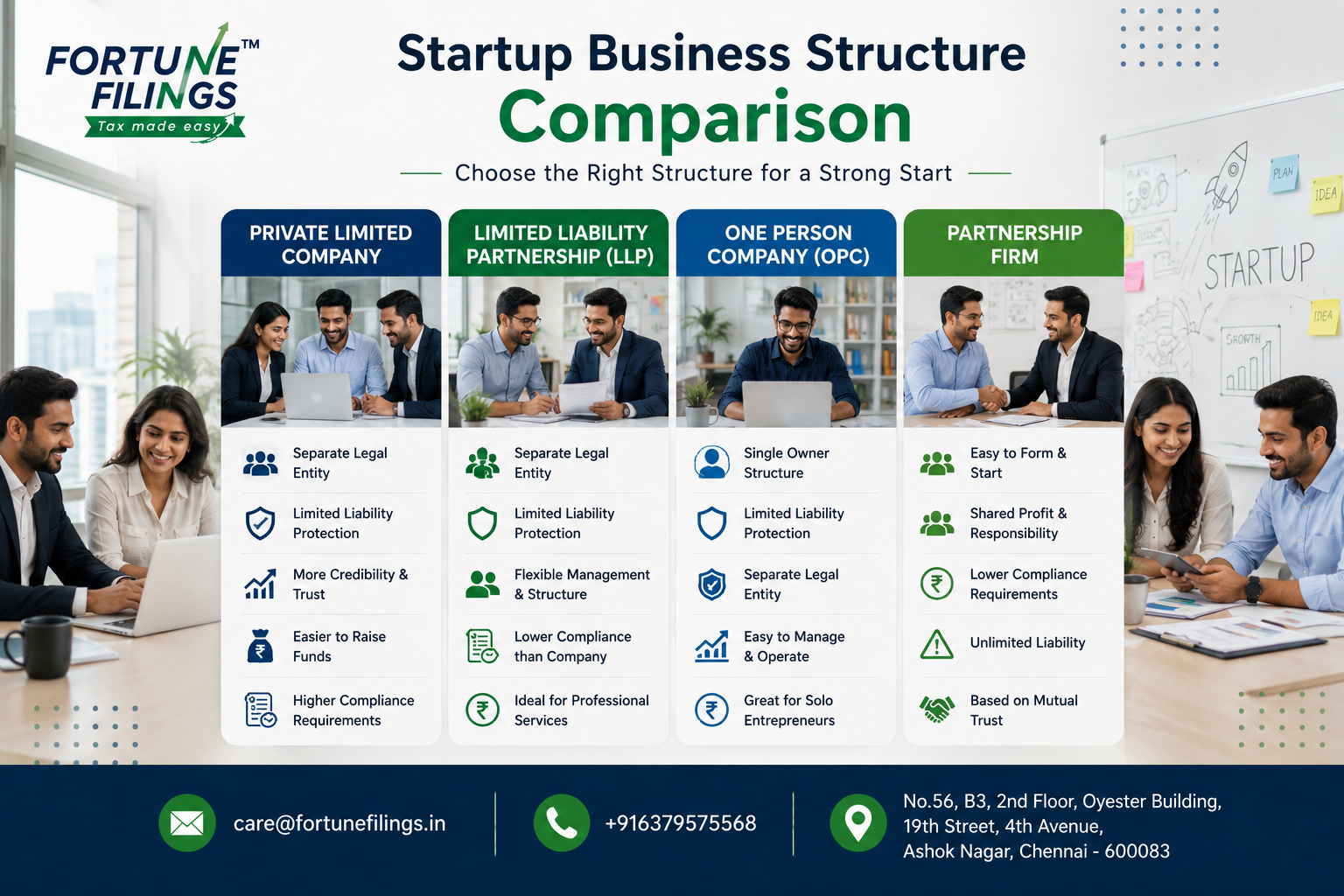
A Private Limited Company is commonly considered by startups that want a structured shareholding model and may look for external investment in the future. An LLP may be more suitable for service-oriented businesses where the founders want a partnership-based structure with limited liability.
An OPC can be considered by an individual entrepreneur who wants to operate through a corporate structure, while a Partnership Firm may work for a business started and managed by multiple partners.
Business Structure | Best For | Investment Potential | Compliance Level |
Private Limited Company | Growing & scalable startups | High | High |
LLP | Service-based businesses | Moderate | Moderate |
OPC | Individual entrepreneurs | Moderate | Moderate |
Partnership Firm | Small businesses with partners | Limited–Moderate | Low |
The best option should be selected after considering both present requirements and future plans. If fundraising, multiple shareholders, or rapid expansion is part of the plan, founders should consider these requirements before registration.
Startup Company Registration Process in Chennai
The registration process generally begins with deciding the business structure and preparing the required information. For a company, the incorporation process is handled through the MCA's online filing system.
Step 1: Choose the Business Structure
First, decide whether your startup should be registered as a Private Limited Company, LLP, OPC, or another suitable structure. This decision should be based on ownership, investment, liability, and future growth.
Step 2: Select a Business Name
The proposed business name should be checked carefully before filing. The name should not create conflicts with an existing company or applicable trademark. MCA guidance also highlights the possibility of rejection where a proposed name is identical or closely resembles an existing company/LLP or conflicts with a registered trademark.
Step 3: Prepare the Documents
Founder details, identity proof, address proof, registered office information, and other applicable documents need to be prepared correctly.
Accurate documentation is important because differences in names, addresses, or other details can lead to clarification requests during the filing process.
Step 4: Complete Online Filing
For company incorporation, the applicable MCA incorporation forms and linked filings are submitted online. The SPICe+ process is used for company incorporation and related services. MCA's official guidance provides detailed requirements for incorporation documents and filings.
Step 5: Government Verification
After submission, the application is reviewed by the relevant authority. If corrections or additional information are required, the applicant needs to respond accordingly.
Step 6: Receive Incorporation Documents
Once the application is approved, the company receives its Certificate of Incorporation along with the applicable registration details.
After incorporation, the business may also need other registrations depending on its activities, employees, turnover, location, and industry.
Documents Required for Startup Registration
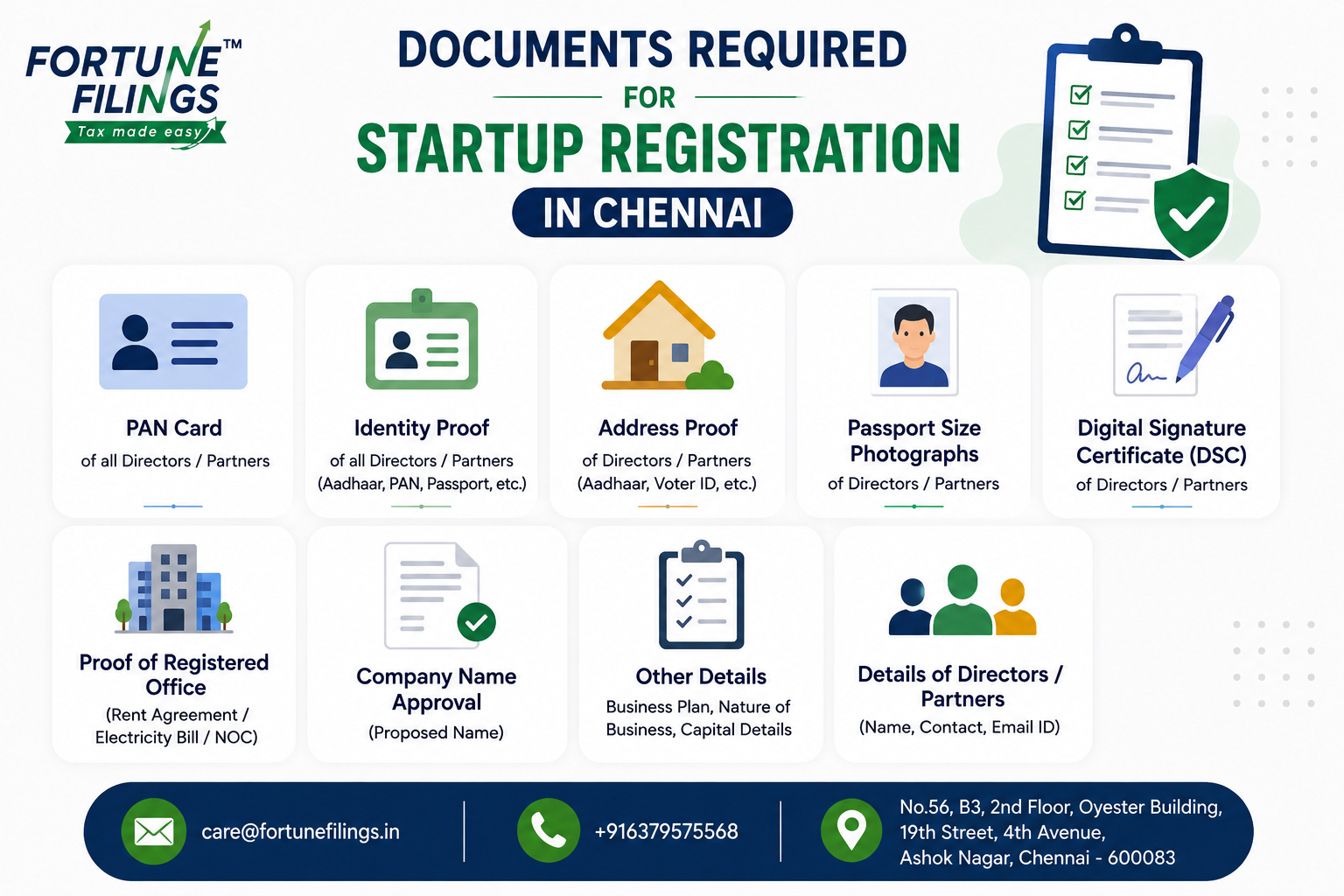
The exact documents can vary depending on the business structure and individual circumstances. However, founders should generally be prepared with identity, address, and registered office-related documents.
Common requirements may include:
✓ PAN and identity proof of founders/directors
✓ Address proof
✓ Photograph, where applicable
✓ Mobile number and email address
✓ Registered office address proof
✓ Rental agreement, where applicable
✓ Owner's NOC, where applicable
✓ Recent utility bill
✓ Business activity details
Preparing these documents in advance can make the registration process smoother and reduce unnecessary delays.
Company Registration vs DPIIT Startup Recognition
One of the most important things entrepreneurs should understand is that company registration and DPIIT Startup Recognition are two different processes.
Company registration creates the legal business entity. DPIIT Startup Recognition, on the other hand, is a separate recognition under the Startup India framework for eligible startups.
According to the current Startup India criteria, eligible entities can include a Private Limited Company, registered Partnership Firm, LLP, or Cooperative Society. Other conditions relating to age, turnover, innovation, and scalability also apply.
Therefore, simply incorporating a company does not automatically mean that the business has DPIIT Startup Recognition. Eligible businesses need to apply separately and satisfy the applicable requirements.
What Has Changed for Startups in 2026?
The startup ecosystem has continued to evolve, and entrepreneurs should pay attention to the latest DPIIT recognition criteria before applying.
Under the current 2026 framework, a non-DeepTech startup can generally be considered a startup for up to 10 years from incorporation or registration, while an eligible DeepTech startup can have a recognition period of up to 20 years. The current turnover threshold is less than ₹200 crore for a non-DeepTech startup and ₹300 crore for a DeepTech startup, subject to the applicable conditions.
This update is particularly relevant for technology-driven businesses and DeepTech ventures that may have longer development cycles.
Startups should not rely only on older articles because government criteria can change. Before applying for DPIIT recognition, founders should check the latest official Startup India requirements.
Benefits of Registering a Startup
Formal registration can provide a structured foundation for running and growing a business. It allows entrepreneurs to establish the business under a recognised legal structure and organise ownership and operations.
For startups planning to work with larger companies, banks, suppliers, or investors, a formal business identity can also support professional credibility.
Depending on the structure and additional registrations, a startup may benefit from:
✓ Formal business identity
✓ Structured ownership
✓ Better business credibility
✓ Support for business banking
✓ Easier management of business contracts
✓ Better preparation for fundraising
✓ Support for future business expansion
DPIIT-recognised startups may also have access to certain Startup India benefits and support mechanisms, subject to eligibility and the specific scheme requirements.
Common Mistakes to Avoid During Startup Registration
Many registration issues can be avoided through proper preparation. Entrepreneurs sometimes select a business structure without considering future funding or choose a name without checking possible conflicts.
Another common mistake is assuming that company incorporation and DPIIT recognition are the same thing. They are separate processes and should be planned separately where applicable.
Before submitting your application, make sure that the founder details, business information, registered office documents, and proposed business name are carefully checked.
It is also important to understand the compliance responsibilities that begin after registration. Incorporating a business is only the beginning; maintaining the required filings and records is an ongoing responsibility.
How to Choose a Startup Registration Service?
For first-time entrepreneurs, the registration process can involve several forms, documents, and government requirements. Professional assistance can help founders understand the process and organise the required documentation.
When choosing a registration service, look for clear communication, transparent pricing, proper document guidance, and support throughout the filing process.
A good service provider should also explain what is included in the registration package and what additional registrations or compliance services may be required after incorporation.
If you are planning Startup Company Registration in Chennai, choosing a service provider that understands both incorporation and startup-related requirements can make the overall process easier.
Frequently Asked Questions
1. What is startup company registration in Chennai?
It is the process of legally establishing a startup under an appropriate business structure in Chennai. The suitable structure depends on the founders, business activity, investment plans, and future growth.
2. Which business structure is best for a startup?
A Private Limited Company is commonly considered by startups planning to scale and potentially raise equity investment. However, LLP, OPC, or Partnership Firm may be more suitable depending on the business model.
3. Is DPIIT registration the same as company registration?
No. Company registration creates the legal entity, while DPIIT Startup Recognition is a separate recognition available to eligible startups under the Startup India framework.
4. What is the DPIIT turnover limit in 2026?
Under the current criteria, the turnover threshold is less than ₹200 crore for non-Deep Tech startup and ₹300 crore for eligible Deep Tech startups subject to the applicable requirements.
5. How long can a startup be recognised under DPIIT?
The current framework provides up to 10 years from incorporation or registration for non-Deep Tech startups and up to 20 years for eligible Deep Tech startups, subject to the applicable conditions.
6. Can startup registration be completed online?
Yes. Company incorporation involves online filing through the MCA system, with the required forms and supporting documents submitted electronically.
7. Do all startups need DPIIT recognition?
No. DPIIT recognition is a separate recognition for eligible startups. A business can be incorporated without automatically receiving DPIIT recognition.
Conclusion
Starting a business requires more than a good idea. Choosing the right legal structure, preparing the correct documents, completing incorporation properly, and understanding ongoing compliance can help create a stronger foundation for long-term growth.
For entrepreneurs planning Startup Company Registration in Chennait, 2026 is also an important year to understand the updated DPIIT framework, especially if the business is innovative, technology-driven, or falls under the DeepTech category.
The registration process becomes easier when founders plan their business structure and documentation before starting the application. With the right approach, entrepreneurs can focus more on building their products, reaching customers, and growing their business.
If you are planning to register your startup and need professional assistance, visit Fortune Filings to understand the available business registration and compliance services. You can also Contact Us for guidance based on your business requirements.